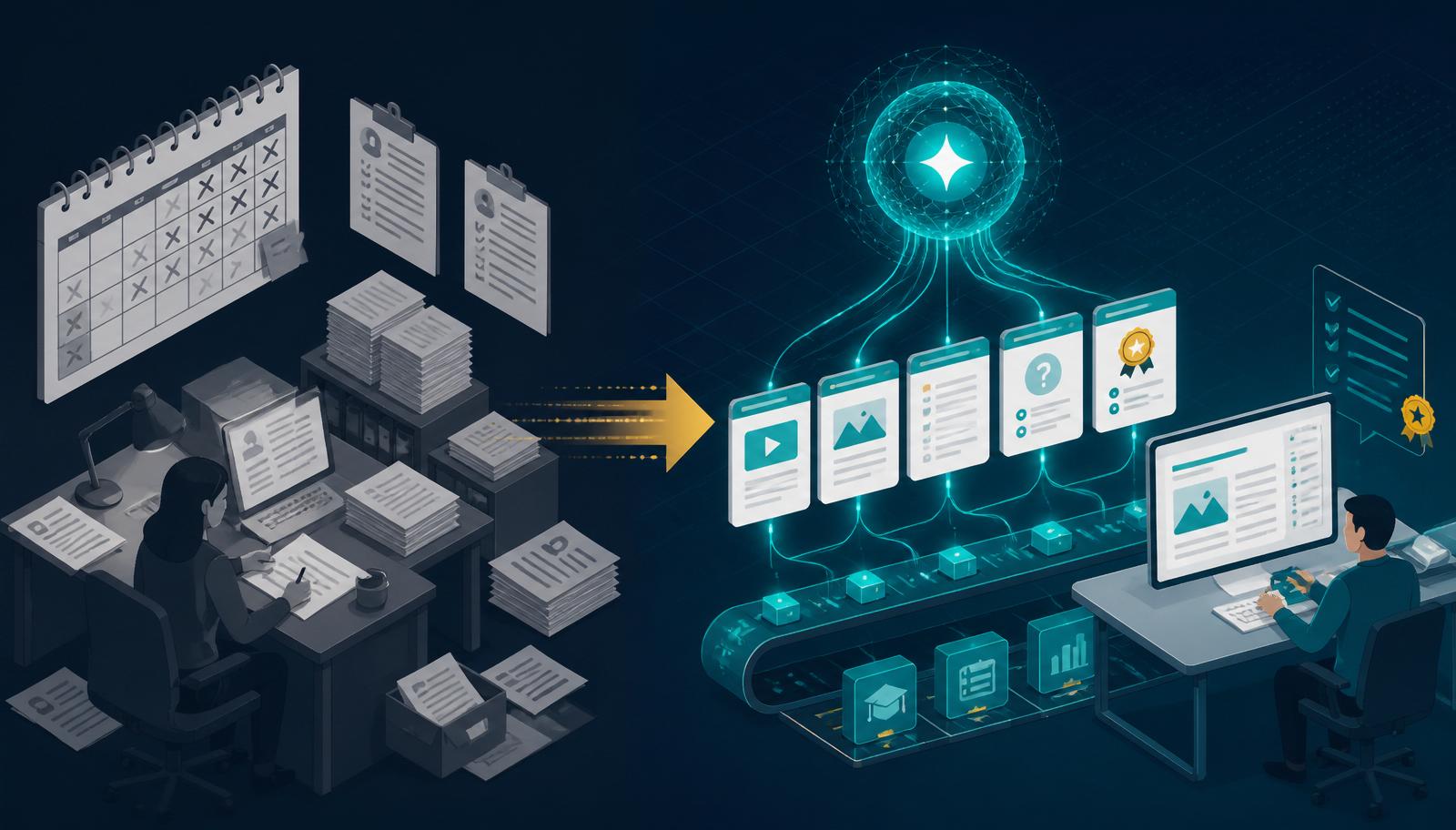
The Myth of Instant Content Creation
“AI generated the course in under five minutes.”
It’s a sentence I’ve heard several times over the past few months.
Usually it’s followed by another one.
“So why are we still waiting six weeks to launch it?”
It’s a fair question.
After all, if AI can write emails, summarise documents, generate presentations and answer complex questions in seconds, surely creating learning content should now be almost instantaneous.
Yet organisations everywhere continue to spend weeks — or even months — developing relatively straightforward training programmes.
So what’s going on? Is AI not as capable as we were promised? Or are organisations approaching the problem from the wrong direction?
The Promise Everyone Bought Into
Artificial Intelligence has fundamentally changed what’s possible in content creation.
Today, a modern Large Language Model can generate:
- learning objectives,
- course outlines,
- knowledge checks,
- scenario-based exercises,
- facilitator notes,
- summaries,
- learner guides,
- assessment questions,
- and even narration scripts,
in just a matter of minutes.
Compared with traditional authoring, it’s nothing short of remarkable.
Naturally, many organisations assumed this would dramatically reduce both the time and cost of producing learning content. And in one sense, they were absolutely right.
AI has changed content creation forever. But perhaps not in the way many expected.
The Wrong Question
One of the most common questions I hear is:
“Can AI create our training courses?”
It’s understandable. But it’s also the wrong question.
A much better question is:
“Which parts of our content development process actually consume the most time?”
Because once you look closely at how learning content is really produced, an interesting pattern begins to emerge.
Writing the first draft is rarely the biggest bottleneck. In many organisations… it’s one of the smallest.
Executive Insight
The right question is not “can AI write our courses?” It is “where does our current content development process actually lose time?” Almost never in the drafting.
Where Projects Really Slow Down
Think about the last compliance course your organisation developed. How much of the project timeline was actually spent writing content?
For many teams, surprisingly little. Most projects are delayed by activities that happen before and after writing. For example:
- waiting for Subject Matter Experts to provide information,
- reviewing multiple document versions,
- validating technical accuracy,
- ensuring regulatory compliance,
- obtaining stakeholder approvals,
- incorporating legal feedback,
- making branding changes,
- publishing into an LMS,
- testing learner experience,
- and repeating the entire cycle whenever something changes.
None of these activities disappear simply because AI can write faster. In fact, if organisations aren’t careful, AI can sometimes make these stages even more demanding by producing large volumes of content that still require careful review.
AI Solves One Problem Exceptionally Well
Artificial Intelligence is extraordinarily good at one specific task: Creating a high-quality first draft.
That’s a genuine breakthrough. Instead of instructional designers spending days developing an initial version of a course, AI can now produce one in minutes. That changes everything.
But only if organisations also rethink the rest of the process.
Because if AI creates the first draft in five minutes… and the organisation still spends six weeks reviewing it… the overall project hasn’t changed very much at all.
The bottleneck has simply moved elsewhere.
The Organisations Seeing the Biggest Gains
The organisations achieving the most impressive results from AI have something in common. They aren’t asking AI to replace instructional designers. They’re redesigning the way learning content is developed.
Rather than viewing AI as another authoring tool, they treat it as a highly capable assistant that removes repetitive work while allowing experts to focus on what humans still do best: making judgements, improving clarity, ensuring accuracy, and creating learning experiences that genuinely change behaviour.
That shift in thinking is subtle. But it’s also where the biggest gains are being realised.
In the next section, we’ll look at what a traditional learning content development process actually looks like — and why many organisations are still following workflows that were designed long before generative AI existed.
The Workflow That AI Didn’t Replace
When organisations first experiment with AI-generated learning content, many experience the same reaction.
“The draft looks surprisingly good.”
Then… nothing happens.
The course sits in review. Subject Matter Experts are busy. Compliance teams want changes. Legal asks for amendments. Branding needs updating. The Learning Management System team hasn’t scheduled deployment yet.
Three weeks later… the course still isn’t live.
If that sounds familiar, it’s because AI has only accelerated one stage of a much larger process.
The Traditional Content Development Process
Although every organisation has its own methodology, most learning content follows a surprisingly similar journey. A typical workflow looks something like this:
Only one of those stages is primarily about writing content. Everything else involves collaboration, validation, governance and decision-making.
That’s why organisations often discover that removing the writing stage doesn’t automatically remove the overall project timeline.
Where Time Really Goes
If you ask most instructional designers what consumes the most time, very few will answer: “Writing.”
Instead, they’ll mention things like:
- Waiting for Subject Matter Experts to review content.
- Chasing stakeholders for feedback.
- Managing multiple document versions.
- Reconciling conflicting comments.
- Reworking content after policy updates.
- Ensuring consistency across dozens of related courses.
- Preparing content for different delivery platforms.
These are coordination problems. Not writing problems. AI cannot solve organisational coordination on its own.
Why Faster Writing Doesn’t Always Mean Faster Delivery
Imagine an organisation that normally spends four weeks developing a compliance course. Perhaps only three days are actually spent writing the content. The remaining time is consumed by reviews, approvals, meetings and publishing.
Now introduce AI. The first draft is produced in fifteen minutes instead of three days. An impressive improvement.
But the project still requires:
- SME validation,
- compliance approval,
- branding review,
- quality assurance,
- accessibility checks,
- publishing,
- learner testing.
The overall project might reduce from four weeks to three. That’s valuable. But it’s nowhere near the dramatic reduction many organisations expected.
The Organisations Seeing the Greatest Return
The organisations gaining the biggest productivity improvements aren’t simply replacing human writers with AI. They’re redesigning the workflow itself.
Instead of treating AI as another authoring tool, they move it to the very beginning of the process. The new workflow looks more like this:
Notice what changed. The instructional designer is no longer spending days creating an initial draft. Instead, they begin with a well-structured foundation and focus on improving it. Their expertise shifts from creating content to improving learning. That’s a much more valuable use of their time.
Instructional Designers Become More Important — Not Less
One of the biggest misconceptions surrounding AI is that instructional designers become less necessary. In reality, the opposite is often true.
As AI takes over repetitive drafting tasks, instructional designers spend more time doing the work that genuinely influences learner outcomes:
- organising information logically,
- designing meaningful learning journeys,
- creating realistic scenarios,
- improving learner engagement,
- reducing cognitive overload,
- ensuring accessibility,
- aligning learning with business objectives.
AI can write. Instructional designers teach. Those are not the same skill.
The New Bottleneck
Ironically, as AI accelerates content creation, another challenge quickly emerges. Organisations discover they can now generate content far faster than they can review it. Instead of waiting for instructional designers… everyone starts waiting for Subject Matter Experts. The bottleneck simply moves.
That isn’t a failure of AI. It’s a sign that the organisation’s operating model hasn’t evolved alongside the technology.
The organisations achieving the greatest success recognise this early. They redesign the entire process — not just the writing stage.
In the next section, we’ll explore exactly where AI creates the greatest value in learning content development, where human expertise remains essential, and why combining both produces significantly better learning outcomes than relying on either alone.
Where AI Creates Real Value (And Where Humans Still Win)
By now, most organisations have accepted that AI can generate learning content. The more important question is no longer:
“Can AI create courses?”
It’s this:
“Which parts of the learning design process should AI own, and which parts should remain firmly in human hands?”
Getting this balance right is the difference between organisations that simply generate more content and those that genuinely improve learning outcomes.
AI Is Brilliant at Starting
One of AI’s greatest strengths is overcoming what writers have always called the “blank page problem.” Instead of beginning with an empty document, instructional designers can now start with a structured first draft containing:
- learning objectives,
- course outlines,
- lesson sequencing,
- knowledge checks,
- quiz questions,
- summaries,
- glossary terms,
- facilitator notes,
- role-play scenarios,
- reflection questions,
- and draft narration.
Tasks that previously consumed several hours — or even days — can often be completed within minutes. That doesn’t mean the content is finished. It means the team starts much further ahead.
AI Excels at Repetitive Work
Learning teams often spend significant time producing content that follows familiar patterns. Examples include:
- rewriting technical documentation into learner-friendly language,
- producing multiple versions of the same content,
- adapting material for different learner groups,
- creating assessment variations,
- generating scenario ideas,
- producing alternative explanations,
- creating summaries for different reading levels,
- and converting classroom materials into eLearning scripts.
These are exactly the kinds of activities where AI consistently performs well. Not because it understands your organisation. But because it recognises patterns remarkably effectively. This allows instructional designers to focus their expertise where it creates the greatest value.
AI Never Gets Tired
Another often-overlooked advantage is consistency. Humans become tired. Deadlines approach. Attention slips. Small inconsistencies appear across large programmes. AI, on the other hand, applies the same instructions every time. That makes it particularly useful for tasks such as:
- maintaining consistent terminology,
- applying organisational writing styles,
- ensuring standard formatting,
- generating large numbers of assessment questions,
- creating multilingual first drafts,
- checking readability,
- identifying duplicated content.
These may not sound exciting. But together they remove hundreds of small repetitive tasks that consume valuable time across learning teams.
Where AI Still Falls Short
Despite its impressive capabilities, AI has important limitations. It does not understand your organisation. It does not know your culture. It cannot judge whether learners are likely to misunderstand a concept. It cannot decide whether a compliance scenario reflects the realities of your business. Nor can it recognise when a policy has changed yesterday but the supporting documentation hasn’t yet been updated.
Most importantly… AI doesn’t understand consequences. It predicts language. Humans understand risk.
AI is strongest at
- Producing structured first drafts
- Generating knowledge checks and assessment variants
- Rewriting technical content in learner-friendly language
- Maintaining terminology and style consistency
- Creating multilingual drafts and readability checks
- Producing content variations at scale
Human expertise is essential for
- Choosing the right learning objective
- Designing scenarios that reflect real work
- Judging cognitive load and engagement
- Interpreting policy, risk and organisational context
- Deciding whether content will change behaviour
- Owning accountability for compliance outcomes
The Human Skills That Matter Even More
As AI becomes increasingly capable of generating content, the role of instructional designers actually becomes more strategic. Their expertise shifts away from producing information and towards shaping learning experiences. They become responsible for questions such as:
- Is this the right learning objective?
- Does this activity encourage behavioural change?
- Will learners remain engaged?
- Is the complexity appropriate?
- Does this reflect how work actually happens?
- Could this content introduce organisational risk?
- Are we teaching knowledge — or improving performance?
These are questions AI cannot answer reliably. Not because the technology is inadequate. But because they require judgement, experience and organisational understanding.
Subject Matter Experts Become Even More Valuable
Interestingly, AI also changes the role of Subject Matter Experts. Historically, SMEs often spent significant time helping instructional designers produce initial content. Now that AI can generate the first draft, SMEs spend less time creating information and more time validating it. That shift is important.
Instead of asking SMEs to write learning content, organisations can ask them to answer questions like:
- Is this accurate?
- Is anything missing?
- Would this advice work in practice?
- Does this reflect our latest policy?
- Are there better examples we should include?
Those conversations create significantly more value than asking busy experts to write entire courses from scratch.
Executive Insight
AI accelerates production. Experts improve quality. Together they create something far stronger than either could achieve independently.
AI Doesn’t Replace Expertise
Perhaps the biggest misconception surrounding AI is that organisations need fewer experts. In reality, successful AI adoption often makes expertise even more valuable. AI accelerates production. Experts improve quality. Together they create something far stronger than either could achieve independently.
The organisations seeing the biggest productivity gains aren’t removing people from the process. They’re allowing those people to spend less time writing and more time thinking. That’s a very different proposition. And it’s why many of the most successful AI implementations aren’t replacing learning professionals. They’re enabling them to produce better work, more consistently, in significantly less time.
The New Competitive Advantage
Ten years ago, organisations competed on how quickly they could produce learning content. Today, AI has largely commoditised the first draft.
The competitive advantage is no longer: “Who can create content fastest?”
It’s becoming: “Who can review, improve and deploy high-quality learning fastest?”
That’s where instructional design, governance, subject expertise and organisational knowledge continue to matter enormously. AI has transformed content creation. It hasn’t eliminated the need for professional judgement. It has simply changed where that judgement delivers the greatest value.
In the next section, we’ll explore how leading organisations are redesigning their entire learning content workflow around AI — and why those changes are reducing delivery times from months to weeks without compromising quality or compliance.
The AI-Enabled Learning Factory
By this point, the pattern should be clear. AI is not a magic button that turns a six-week learning project into a five-minute task. What it can do is remove the slowest repetitive work from the process.
The organisations seeing the largest gains have stopped thinking of AI as an authoring tool and started treating it as part of a new operating model for learning content production. In other words, they are building an AI-enabled learning factory.
The Old Model: Sequential and Slow
Traditional learning projects are usually highly sequential. A business request arrives. An instructional designer waits for SME input. The first draft is created. The SME reviews it. Compliance reviews it. Legal reviews it. Quality assurance reviews it. Publishing reviews it. If any reviewer requests changes, the content often loops back several steps.
The result is a process where work spends more time waiting than being actively developed.
The New Model: Parallel and AI-Assisted
Leading organisations are redesigning the workflow so that AI accelerates the earliest stages and humans focus on validation and improvement. A simplified AI-enabled workflow looks like this:
The critical difference is that review activities happen in parallel wherever possible, while AI removes the need for lengthy initial drafting.
What Changes in Practice?
Before AI
- SMEs spend hours explaining basic concepts.
- Instructional designers create the first draft from scratch.
- Reviewers comment on structure, content and wording simultaneously.
- Multiple document versions circulate by email.
- Publishing is treated as a separate handoff.
After AI
- SMEs provide a focused briefing and key source documents.
- AI generates a structured first draft.
- Instructional designers refine learning flow and learner experience.
- SMEs validate accuracy while compliance validates regulatory requirements.
- Comments are consolidated in a single workflow.
- Publishing is integrated into the development pipeline.
The process becomes shorter, more parallel and far easier to govern.
The 80/20 Shift
One of the most significant changes is how learning professionals spend their time.
Traditional allocation
- 80% drafting, formatting and reworking content
- 20% improving learning quality
AI-enabled allocation
- 20% generating and preparing content
- 80% improving learning quality, scenarios, assessments and learner outcomes
This is the real productivity gain. AI does not eliminate the instructional designer; it allows the instructional designer to spend far more time on the work that actually improves learning effectiveness.
Governance Becomes More Important, Not Less
A common misconception is that faster content creation means less governance. In practice, the opposite is true. Because AI can generate large volumes of content quickly, organisations need clear controls around:
- approved source documents,
- prompt management,
- version control,
- review responsibilities,
- audit trails,
- compliance sign-off,
- and publishing permissions.
The most successful implementations treat AI-generated content as draft content by default. Nothing reaches learners until it has passed the same governance checks as traditionally authored material. This approach maintains trust while still capturing the speed advantages of AI.
A Realistic Timeline
What should organisations realistically expect? For a typical compliance or operational training module:
| Stage | Traditional | AI-Enabled |
|---|---|---|
| First draft | 3–5 days | 15–30 minutes |
| Instructional refinement | 2–3 days | 1–2 days |
| SME review | 3–7 days | 2–5 days |
| Compliance & QA | 3–5 days | 3–5 days |
| Publishing & testing | 2–3 days | 1–2 days |
| Total | 13–23 days | 7–15 days |
Notice that the largest reduction comes from eliminating lengthy drafting and reducing rework. Governance stages remain largely intact — and they should.
The Most Successful Starting Point
Organisations often try to apply AI to every learning project at once. That is rarely the best approach. A better starting point is to identify a high-volume, repeatable content type, such as:
- annual compliance refreshers,
- policy updates,
- product knowledge modules,
- onboarding courses,
- standard operating procedure training,
- or customer support knowledge updates.
These areas usually have clear source material, predictable structure, frequent updates, and measurable development effort. They provide the fastest route to demonstrating value.
The New KPI
Historically, many learning teams measured success by time to first draft. In an AI-enabled world, that metric becomes almost meaningless. A more useful KPI is:
Time from approved business requirement to learner-ready release.
That metric captures the entire workflow, including governance, review and deployment. It reflects what the business actually cares about: how quickly high-quality learning reaches learners.
The organisations that redesign their workflow around this metric are the ones turning AI from an interesting experiment into a measurable operational advantage.
In the final section, we will look at how executives should evaluate AI for learning content development, the mistakes to avoid, and a practical 90-day roadmap for implementing an AI-enabled learning workflow without disrupting existing learning operations.
From Storyboard to Published Course
One question comes up repeatedly whenever I speak with Learning & Development teams.
“Once our storyboard is approved, can AI build the course?”
The answer is: Increasingly, yes. But the answer deserves some explanation.
For many years, the biggest effort in eLearning development wasn’t creating the storyboard. It was everything that happened afterwards.
Instructional designers would manually recreate the approved storyboard inside an authoring tool, build every interaction, format every page, insert images, create assessments, record narration, optimise layouts and finally publish the course for testing.
Even relatively straightforward compliance courses could require days of production effort after the storyboard had already been signed off.
This is exactly where AI is beginning to make a significant difference.
AI Is Transforming Course Production
Once learning objectives, content structure and instructional approach have been agreed, AI can now accelerate many of the production tasks that traditionally required extensive manual effort. Depending on the organisation’s preferred tools and workflows, AI can assist with generating:
- HTML learning pages
- Interactive accordions
- Expandable content panels
- Knowledge checks
- Multiple-choice assessments
- Scenario-based learning activities
- Reflection questions
- Flip cards
- Timelines
- Glossaries
- Infographics
- Learner summaries
- Accessibility improvements
- Image suggestions
- Narration scripts
- Video storyboards
Rather than building every component manually, instructional designers increasingly begin with AI-generated components which they review, refine and assemble into the finished learning experience.
AI Doesn’t Replace Authoring Tools
One common misconception is that AI replaces platforms such as Rise 360, Storyline, Adapt or custom HTML learning environments. In reality, AI complements them.
Authoring platforms remain responsible for:
- learner experience,
- responsive layouts,
- SCORM packaging,
- accessibility,
- interaction management,
- LMS compatibility.
AI accelerates content creation within that process. It doesn’t eliminate the need for professional authoring platforms.
From Storyboard to Course — A New Workflow
Traditionally, an approved storyboard marked the beginning of a lengthy production phase. Today’s workflow increasingly looks like this:
Notice what changed. The storyboard remains the foundation. AI simply accelerates everything that follows.
What AI Still Doesn’t Do Well
This is where experience still matters enormously.
AI can generate interactions. It cannot judge whether those interactions create meaningful learning. AI can produce HTML. It cannot determine whether learners will understand the material. AI can suggest graphics. It cannot know whether those visuals reinforce the learning objectives.
Similarly, AI cannot reliably decide:
- whether content meets regulatory expectations,
- whether scenarios reflect organisational reality,
- whether the learning experience is engaging,
- whether cognitive load is appropriate,
- whether assessments genuinely measure competence.
Those decisions still require instructional designers, learning consultants and Subject Matter Experts.
Faster Production Doesn’t Mean Lower Quality
One concern many organisations have is that AI-generated content will inevitably reduce learning quality. In practice, the opposite is often true.
When AI removes repetitive production tasks, instructional designers spend more time on activities that genuinely improve learning outcomes:
- improving learner engagement,
- refining scenarios,
- validating assessments,
- strengthening accessibility,
- aligning learning with business objectives.
The quality improves because experts spend less time formatting content — and more time improving it.
Choosing the Right Production Approach
Not every organisation needs the same solution. Depending on your existing ecosystem, AI-assisted development may involve different approaches. For example:
| Requirement | Possible AI-Assisted Approach |
|---|---|
| Rapid compliance training | AI-generated HTML learning pages |
| Existing LMS with SCORM | AI-assisted SCORM authoring in tools like Rise or Storyline |
| Highly interactive learning | AI-generated first drafts with manual interaction design |
| Product knowledge | AI-assisted content generation combined with SME validation |
| Frequently changing content | AI-generated updates from approved source documents |
The objective isn’t to replace your current authoring tools. It’s to reduce the amount of manual effort required inside them.
The Biggest Opportunity
Perhaps the greatest opportunity isn’t simply producing courses faster. It’s producing more high-quality learning with the same team.
Organisations no longer have to choose between speed and quality. With the right workflow, AI enables both.
The Future of Learning Content Development
If there’s one lesson organisations are discovering from their first wave of AI adoption, it’s this:
AI doesn’t replace the learning content development process. It redesigns it.
The organisations seeing the greatest return on AI investment haven’t simply purchased new technology. They’ve fundamentally changed how work gets done.
And that’s an important distinction. Technology creates potential. Process creates results.
The Organisations That Will Move Fast
Over the next few years, the competitive advantage won’t belong to organisations with the biggest AI budgets. Nor will it belong to those using the latest Large Language Model. It will belong to organisations that redesign their operating model around AI.
That means asking different questions. Instead of asking: “Can AI create our training content?”
Ask:
- Which tasks are repetitive?
- Which activities consume the most time?
- Where are our review bottlenecks?
- Where does expert judgement create the greatest value?
- Which parts of the workflow should AI accelerate?
Those organisations will move significantly faster than those simply adding AI to existing processes.
A Practical 90-Day Starting Point
One mistake I frequently see is organisations attempting to transform every aspect of content development at once. That rarely succeeds. A better approach is to begin with a small, measurable pilot.
Month One
Identify one type of learning content that follows a repeatable structure — for example: induction programmes, compliance modules, policy updates, product knowledge, or health and safety refreshers. Use AI to generate the first draft only. Don’t change the rest of the process. Measure the time saved.
Month Two
Introduce AI into supporting activities: quiz generation, scenario creation, learning summaries, facilitator guides, alternative explanations, accessibility improvements. Again, measure quality alongside productivity.
Month Three
Review the entire workflow. Ask: Which reviews added value? Which approvals were unnecessary? Where did SMEs spend their time? Which repetitive tasks disappeared? Which activities still delayed delivery? Only after understanding these answers should organisations redesign the wider process.
The Role of AI Will Continue to Evolve
Today’s AI is remarkably capable. Tomorrow’s AI will be even better. Models will improve. Authoring tools will improve. Content generation will become increasingly sophisticated.
But one thing is unlikely to change. Organisations will still need people who understand:
- learners,
- business objectives,
- organisational culture,
- compliance,
- behavioural change,
- and performance improvement.
Those capabilities aren’t disappearing. They’re becoming more valuable. Because as AI makes content creation easier, the quality of human judgement becomes the primary differentiator.
From Content Creators to Learning Architects
Perhaps the biggest transformation isn’t technological. It’s professional.
Instructional designers are gradually moving away from being content creators. They’re becoming learning architects. Their role is shifting towards:
- designing learning journeys,
- validating AI outputs,
- improving learner engagement,
- aligning learning with business goals,
- ensuring governance,
- and creating measurable business outcomes.
That’s a more strategic role than ever before. And it’s one that AI strengthens rather than replaces.
Final Thoughts
Every significant technology shift follows a familiar pattern. Initially, organisations attempt to use the new technology to improve existing processes. Only later do they redesign the process itself.
We’re currently at exactly that point with AI. Many organisations are asking AI to help them write courses faster. The organisations leading the way are asking a much bigger question:
“If AI can create a first draft in minutes, how should our entire learning content development process change?”
That’s where the real opportunity lies. Not in replacing instructional designers. Not in eliminating Subject Matter Experts. Not in automating every decision. But in allowing talented people to spend less time producing content… and significantly more time creating learning that genuinely changes behaviour.
Ultimately, AI doesn’t reduce the importance of expertise. It amplifies it. And for organisations willing to rethink the way they create learning, that’s where the greatest competitive advantage will be found.
Key Takeaways
Before introducing AI into your learning content development process, remember these five principles:
- AI accelerates drafting — not organisational decision-making.
- The biggest bottlenecks are usually reviews and approvals, not writing.
- Instructional designers become more valuable as AI removes repetitive work.
- Subject Matter Experts should validate knowledge, not create first drafts.
- The greatest gains come from redesigning the workflow, not simply adding AI to it.
The future of learning isn’t about replacing people with AI. It’s about enabling people to produce better learning, faster, with the support of AI. That’s a very different — and far more powerful — vision.
About the Author
Vikram Katyani is the Founder of IntelliMinds Digital, where he helps organisations move from AI curiosity to measurable business outcomes. His work focuses on AI strategy, AI readiness, custom AI development, prototype-to-production engineering and the long-term operation of AI systems in real business environments.