Introduction
Almost every leadership team I speak with asks some version of the same question.
"How do we actually start?"
Not:
Which AI model should we use?
Not:
Should we build or buy?
But something far more practical.
How do we introduce AI without disrupting the business?
It's a sensible concern.
Every organisation already has systems.
Processes.
Customers.
Employees.
Deadlines.
Introducing AI into that environment isn't simply a technology exercise.
It's organisational change.
And history has shown that organisational change succeeds far more often when people understand why it's happening—not just what is changing.
AI Adoption Is A Leadership Challenge
Many people still view AI as an IT initiative.
I don't.
Technology teams absolutely play a critical role.
But successful adoption depends just as much on leadership.
Because AI changes how people work.
Managers need confidence.
Employees need clarity.
Executives need measurable outcomes.
Without visible leadership support, AI often becomes another interesting experiment that gradually loses momentum.
Successful organisations don't delegate AI entirely to technology teams.
Leadership remains actively involved throughout the journey.
Start With A Business Objective
One temptation is to begin by exploring everything AI could potentially do.
That usually creates more confusion than clarity.
Instead, start with one business objective.
For example:
- Improve proposal turnaround.
- Reduce customer response times.
- Increase employee productivity.
- Simplify compliance.
- Improve knowledge sharing.
- Reduce repetitive administration.
Once the objective is clear, AI becomes much easier to evaluate.
Technology starts supporting strategy instead of driving it.
Don't Announce A Transformation Programme
This may sound counterintuitive.
But I rarely recommend announcing a company-wide AI transformation programme.
Large announcements create large expectations.
Employees begin imagining dramatic change.
Some become excited.
Others become anxious.
Neither reaction is particularly helpful.
Instead, successful organisations often begin quietly.
One team.
One workflow.
One measurable improvement.
When people see colleagues benefiting from AI rather than simply hearing presentations about it, curiosity replaces scepticism.
That's a much healthier foundation for long-term adoption.
Choose The First Team Carefully
Not every department should become the first AI pilot.
The ideal team usually has three characteristics.
First, they experience obvious operational friction.
Second, leadership supports experimentation.
Third, success can be measured clearly.
Proposal teams are often excellent candidates.
Customer support teams frequently are too.
Knowledge-intensive operational teams also work well.
The goal isn't simply delivering an AI solution.
It's creating a visible success story that other departments naturally want to replicate.
Involve Employees Early
One mistake organisations occasionally make is designing AI for employees without involving them.
Ironically, the people doing the work usually know exactly where AI could help.
Ask them:
- Which tasks are repetitive?
- Which information is difficult to find?
- Which activities consume too much time?
- Which processes create frustration?
The answers are often remarkably consistent.
People are much more likely to embrace AI when they recognise their own challenges reflected in the solution.
AI shouldn't feel imposed.
It should feel helpful.
Focus On Confidence Before Scale
Perhaps the most important objective during the first few months isn't productivity.
It's confidence.
Employees need confidence that AI supports their work.
Managers need confidence that it improves performance.
Leadership needs confidence that investment is justified.
Once confidence exists, scaling AI across the organisation becomes significantly easier.
Without confidence, even excellent technology struggles to gain traction.
That's why the first project matters so much.
You're not simply deploying AI.
You're shaping how the organisation thinks about AI itself.
The Journey Is Different For Every Organisation
There isn't a universal AI roadmap.
A manufacturing company begins differently from a law firm.
A consultancy has different priorities from a retailer.
A 100-person organisation moves differently from a global enterprise.
That's why successful AI programmes rarely start with technology.
They start with understanding the organisation itself.
Because AI works best when it adapts to the business—not when the business is forced to adapt to AI.
In the next section we'll explore the practical steps successful organisations follow during the first 12 months of AI adoption.
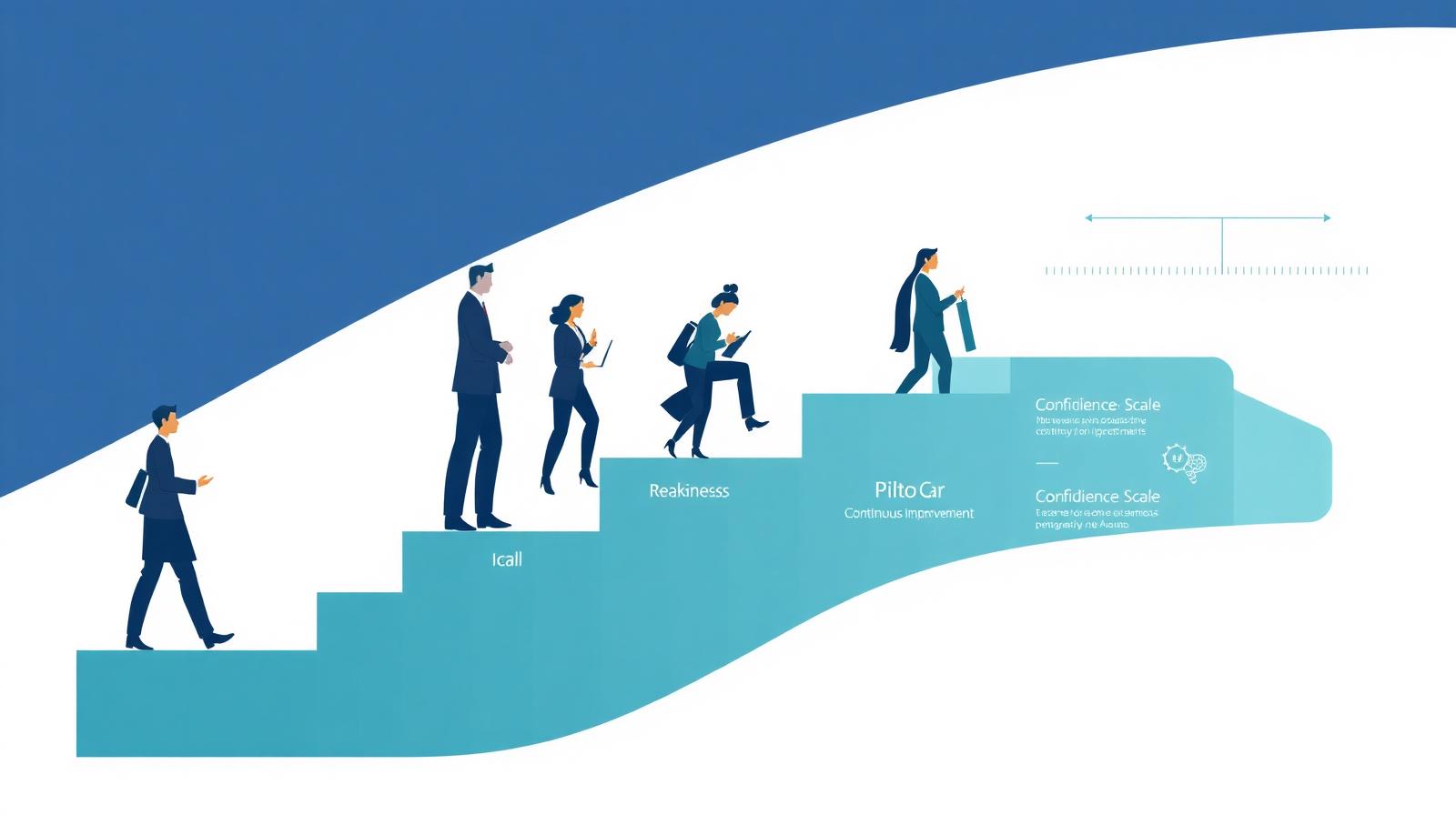
The First 12 Months: A Practical AI Adoption Roadmap
One of the biggest misconceptions about AI is that organisations need a comprehensive transformation programme before they can begin.
In reality, the most successful organisations rarely start that way.
Instead, they build capability gradually.
They learn.
They refine.
They expand.
By the end of the first year, they often have far stronger AI foundations than organisations attempting to transform everything simultaneously.
Here's what that journey often looks like.
Months 1–2: Understand Before You Invest
The first stage shouldn't involve buying software.
It should involve understanding the organisation.
Questions worth asking include:
- Which business objectives matter most this year?
- Where are operational bottlenecks?
- Which teams spend the most time on repetitive work?
- Where does valuable knowledge already exist?
- What concerns do employees have about AI?
- Which processes genuinely differentiate the business?
This is also the ideal time to assess AI readiness across:
- strategy
- people
- processes
- technology
- data
- governance
Skipping this stage often leads to expensive decisions later.
The organisations moving fastest usually spend more time planning than people expect.
Months 2–4: Select One High-Value Pilot
Once priorities are understood, choose a single initiative.
Not five.
Not ten.
One.
The ideal pilot should satisfy three conditions:
It solves a genuine business problem.
The objective should be measurable.
For example:
- reducing proposal preparation time
- improving knowledge retrieval
- accelerating customer responses
- reducing repetitive administration
People actually want it.
Employees should immediately recognise the value.
If the pilot removes work they dislike, adoption becomes much easier.
If it creates additional work, resistance increases.
Success can be measured.
Examples include:
- hours saved
- response times
- proposal turnaround
- customer satisfaction
- employee productivity
- reduction in manual effort
Measurable success creates organisational credibility.
Months 4–6: Learn More Than You Build
This stage surprises many organisations.
The technology often performs well.
The learning comes from people.
Questions emerge such as:
- Which prompts produce the best results?
- Where does AI struggle?
- Which workflows need redesigning?
- What information is missing?
- What governance is required?
- Which approvals remain necessary?
These lessons are incredibly valuable.
Because they influence every future AI initiative.
Successful organisations don't judge pilots solely by technical performance.
They judge them by organisational learning.
Months 6–9: Build Internal Confidence
At this point something interesting begins happening.
Employees start recommending ideas.
Managers begin identifying additional opportunities.
Departments become curious.
The conversation changes from:
"Should we use AI?"
to
"Could AI help us here as well?"
That's an important milestone.
AI has moved beyond experimentation.
It has become a practical business tool.
This is usually the right time to begin evaluating additional opportunities—not because leadership insists, but because the organisation itself has developed confidence.
Months 9–12: Create An AI Operating Model
Many organisations assume deployment completes the project.
Actually, the first year is where long-term capability begins taking shape.
Questions now become operational:
- Who owns each AI system?
- How are prompts maintained?
- How is knowledge updated?
- How are improvements prioritised?
- How are new AI opportunities evaluated?
- How will governance evolve?
- What metrics should leadership review?
Rather than managing isolated projects, organisations begin managing an AI portfolio.
That's a significant shift.
It signals the organisation is building capability—not simply deploying software.
Communication Matters Throughout
One observation has remained remarkably consistent.
The organisations achieving the greatest adoption communicate constantly.
They don't simply announce AI.
They explain:
- why it's being introduced
- what problem it's solving
- how success will be measured
- where employees can contribute
- how feedback influences future improvements
Transparency reduces uncertainty.
People rarely resist technology.
They resist uncertainty.
The more clearly leaders communicate, the easier adoption becomes.
Small Wins Create Large Momentum
Perhaps the biggest lesson from successful AI programmes is this:
Momentum matters.
One successful project creates trust.
Trust creates curiosity.
Curiosity generates ideas.
Ideas produce further investment.
Eventually AI becomes something employees actively request rather than something leadership has to promote.
That journey almost always begins with one carefully chosen project—not a company-wide transformation programme.
Building An AI Culture Instead Of AI Projects
By this stage, the organisation has usually delivered one or two successful AI initiatives.
The technology is working.
People are beginning to trust it.
Leadership can see measurable value.
This is where the next challenge begins.
How do you move beyond isolated AI projects and create an organisation that continuously identifies and delivers AI opportunities?
The answer isn't buying more software.
It's building the right culture.
Make AI Part Of Everyday Conversations
One characteristic of organisations successfully adopting AI is that AI gradually becomes part of normal business conversations.
Managers begin asking:
"Could AI help with this process?"
Employees ask:
"Could we automate this task?"
Project teams ask:
"Can we use AI to reduce manual effort?"
Notice something important.
Nobody is asking:
"How can we use ChatGPT?"
The conversation shifts from technology to outcomes.
That's exactly where it should be.
When AI becomes another tool for solving business problems, adoption accelerates naturally.
Encourage Curiosity, Not Fear
Whenever new technology appears, uncertainty follows.
Employees often worry about questions like:
- Will AI replace my role?
- Will management monitor my work?
- Can I trust AI's recommendations?
- What happens if AI makes a mistake?
Ignoring these concerns rarely helps.
Successful organisations address them openly.
They explain:
- AI assists people—it doesn't replace judgement.
- Employees remain accountable for important decisions.
- AI removes repetitive work so people can focus on higher-value activities.
- Feedback is encouraged because AI systems improve over time.
Transparency creates trust.
Trust creates adoption.
Celebrate Business Outcomes—Not Technology
It's easy to become excited about impressive AI capabilities.
But employees don't become motivated because a model is larger or faster.
They become motivated when work becomes easier.
Celebrate examples like:
- A proposal completed in half the usual time.
- A customer issue resolved more quickly.
- An employee finding information in seconds rather than minutes.
- A compliance review completed with fewer manual checks.
Those stories resonate.
They're relatable.
People begin seeing AI as something that helps colleagues—not something imposed by leadership.
Success stories are often the most effective adoption strategy available.
Give Every Team Permission To Suggest Ideas
One mistake organisations occasionally make is assuming AI ideas should come from senior leadership.
In reality, the best opportunities often come from the people closest to the work.
Encourage teams to ask:
- Which tasks frustrate us?
- Which activities are repeated every day?
- Which approvals slow us down?
- Which information is difficult to locate?
- Which decisions require reviewing large volumes of documents?
Most organisations don't suffer from a shortage of AI opportunities.
They simply haven't created a process for discovering them consistently.
Create Simple AI Governance
As AI adoption grows, governance becomes increasingly important.
Fortunately, governance doesn't have to be complicated.
Every organisation should have straightforward guidance covering questions such as:
- Which AI tools are approved?
- What information should never be shared with public AI models?
- When is human review mandatory?
- Who approves new AI initiatives?
- How are AI systems monitored?
- Who owns each deployed solution?
Clear governance enables innovation.
Poor governance usually creates hesitation.
Employees become more confident when expectations are obvious.
Develop Internal AI Champions
One pattern appears in almost every successful organisation.
They develop internal champions.
These aren't necessarily AI specialists.
They're people who enjoy improving processes.
They experiment.
Share ideas.
Help colleagues.
Provide feedback.
Demonstrate success.
Over time these individuals become catalysts for adoption across the organisation.
Leadership doesn't need to drive every conversation.
The organisation begins driving change itself.
Continuous Learning Matters More Than Continuous Buying
The AI market evolves incredibly quickly.
New models appear almost every month.
It can feel overwhelming.
Successful organisations don't attempt to evaluate every announcement.
Instead they focus on learning.
They ask:
- What worked?
- What didn't?
- What did employees find useful?
- Which workflows produced measurable value?
- What should we improve next?
Learning compounds.
Over time organisations become significantly better at identifying valuable AI opportunities—not because technology slowed down, but because their decision-making improved.
AI Adoption Is Ultimately About People
This is perhaps the most important lesson of all.
Organisations don't become AI-enabled because they purchase software.
They become AI-enabled because people begin working differently.
Technology enables that change.
Leadership supports that change.
Culture sustains that change.
Without people, AI remains an interesting demonstration.
With people, it becomes a genuine competitive advantage.
That's why successful organisations invest just as much in communication, trust and learning as they do in technology itself.
Bringing It All Together: AI Adoption Is a Journey, Not a Launch
If there's one idea I'd like every executive to remember, it's this:
Successful AI adoption is not a technology project. It's an organisational capability that develops over time.
The organisations creating the greatest value from AI aren't necessarily the ones spending the most money.
They're the ones introducing AI thoughtfully.
Building confidence.
Learning continuously.
And expanding only after they've demonstrated measurable success.
Don't Measure Success By The Number Of AI Projects
It's tempting to judge AI maturity by asking questions like:
- How many AI tools are we using?
- How many pilots have we launched?
- How many departments have adopted AI?
Those metrics can be misleading.
A better question is:
"Has AI made the organisation measurably better?"
For example:
- Are proposals completed faster?
- Are customers receiving better service?
- Are employees spending less time on repetitive work?
- Are managers making better decisions?
- Has operational efficiency improved?
Those outcomes matter.
Everything else is simply activity.
Build Confidence Before You Build Complexity
Many organisations assume maturity means implementing increasingly sophisticated AI.
In reality, maturity usually means something much simpler.
It means the organisation has confidence.
Confidence to identify opportunities.
Confidence to deploy responsibly.
Confidence to measure results.
Confidence to improve continuously.
Complex technology without organisational confidence rarely succeeds.
Organisational confidence allows surprisingly simple AI solutions to deliver exceptional value.
AI Should Become Invisible
One of the most exciting signs of successful adoption is when people stop talking about AI altogether.
Instead they say things like:
"The proposal process is much quicker."
"Finding information is much easier."
"Customer queries are resolved faster."
Notice what's missing.
Nobody is celebrating the AI.
They're celebrating better business outcomes.
That's exactly where AI should end up.
Like cloud computing or email before it, AI will gradually become part of normal business operations rather than something viewed as special.
When people stop noticing the technology and simply appreciate the improvement, you've reached real maturity.
Every Organisation Moves At Its Own Pace
There isn't a universal AI roadmap.
Some organisations begin with customer support.
Others begin with proposal automation.
Some focus on knowledge management.
Others prioritise operational efficiency.
None of these approaches is inherently right or wrong.
What matters is choosing the next step that's right for your organisation.
The best AI strategy isn't the one that's moving fastest.
It's the one that's creating sustainable business value.
A Practical Executive Checklist
If you're introducing AI into your organisation, ask yourself these questions.
Strategy
- Do we know exactly what business problem we're solving?
- Is success clearly measurable?
Leadership
- Is executive sponsorship visible?
- Does someone own the initiative?
People
- Have employees been involved?
- Have concerns been addressed openly?
- Do people understand how AI supports their work?
Governance
- Are policies clear?
- Do employees know which tools are approved?
- Are responsibilities well defined?
Operations
- Do we have a plan for monitoring and continuous improvement?
- Who maintains the AI system after deployment?
- How will we identify future opportunities?
If these questions have good answers, your organisation is already ahead of many beginning their AI journey.
AI Adoption Never Really Finishes
One final observation.
Many organisations ask:
"When will our AI transformation be complete?"
The honest answer is:
Probably never.
Not because projects fail.
Because AI will continue evolving.
New opportunities will emerge.
Processes will improve.
Technology will mature.
Business priorities will change.
Successful organisations don't view this as a never-ending project.
They view it as continuous improvement.
Exactly the same way they approach customer service, operational excellence or digital transformation.
AI simply becomes another capability the organisation develops year after year.
Key Takeaways
- AI adoption is an organisational change programme—not simply a technology implementation.
- Small, measurable successes create more momentum than large transformation programmes.
- Leadership, communication and employee confidence are essential for long-term success.
- Governance should enable innovation rather than restrict it.
- AI maturity is measured by business outcomes, not the number of AI projects.
- The organisations creating the greatest value treat AI as an ongoing capability rather than a one-time initiative.
Where Should You Begin?
Most organisations don't need another AI demonstration.
They need clarity.
Clarity about:
- where AI will create the greatest value
- which project should come first
- what risks need addressing
- how prepared the organisation really is
That's exactly why we created the AI Readiness Assessment.
In around five minutes you'll receive:
- Your AI Readiness Score
- A structured assessment across strategy, people, processes, technology, data and governance
- Your highest-value AI opportunities
- Key implementation risks
- Practical recommendations for the next stage of your AI journey
It's designed to help organisations move from curiosity to confident decision-making.
Continue The Conversation
At IntelliMinds Digital, we help organisations introduce AI in ways that strengthen the business—not disrupt it.
Our services include:
- AI Readiness Assessments
- AI Strategy & Roadmaps
- AI Opportunity Discovery Workshops
- Custom AI Development
- AI Automation
- Prototype to Production
- Managed AI Hosting & Long-term Support
Because successful AI adoption isn't about implementing the most technology.
It's about helping people achieve better business outcomes every single day.
Relevant Services
- AI Readiness Assessment — structured diagnostic of strategy, data, technology, governance and people.
- AI Strategy Consulting — decide where AI investment will and will not pay back.
- Custom AI Development — build the AI workflow, tightly fitted to how your business actually operates.
- Prototype to Production — take a working prototype to a secure, monitored production system.
- Managed AI Hosting — ongoing operation, monitoring and improvement of live AI systems.
Author
Vikram Katyani — Founder, IntelliMinds Digital.
Helping organisations introduce AI with confidence by combining practical strategy, production-ready delivery and long-term operational support. Every successful AI journey starts with understanding the business before selecting the technology.