Introduction
One question appears in almost every early AI conversation.
"Should we build our own AI system—or simply buy one?"
It's an excellent question.
Unfortunately, many organisations ask it too late.
By the time development has started, significant time and budget have already been committed.
The decision should actually be made much earlier.
Because choosing between buying and building isn't primarily a technology decision.
It's a business decision.
The objective isn't owning AI.
The objective is solving a business problem in the most effective way possible.
Sometimes that means building something unique.
Sometimes it means spending £50 per month on an existing product.
Both can be excellent decisions.
The Biggest Mistake Organisations Make
The biggest mistake isn't choosing the wrong technology.
It's assuming custom software is automatically better.
Or assuming packaged software is always cheaper.
Neither is true.
Every organisation sits somewhere on a spectrum.
At one end are businesses whose requirements are almost identical to thousands of others.
At the other are organisations whose processes genuinely create competitive advantage.
Those organisations often need something different.
Understanding where you sit on that spectrum is far more important than comparing AI models.
When Buying Makes Perfect Sense
There are already exceptional AI tools available for:
- meeting transcription
- document summarisation
- grammar improvement
- image generation
- coding assistance
- marketing content
- sales prospecting
- customer support
If one of these products already solves 90% of your problem, buying is usually the right decision.
There is little value in spending months rebuilding software that already exists.
Your competitive advantage rarely comes from owning a meeting transcription platform.
It comes from how your organisation operates.
One of the most valuable conversations I have with clients sometimes ends with:
"Don't build this. Buy that instead."
Those conversations usually strengthen relationships because they demonstrate independence rather than selling development for its own sake.
When Buying Starts To Break Down
Packaged software becomes less attractive when organisations begin saying things like:
"Our process is different."
Sometimes they're wrong.
Many businesses believe they're unique when they actually follow fairly standard workflows.
But occasionally they're absolutely right.
For example:
A proposal team with a highly specialised approval process.
A compliance workflow unique to one industry.
An internal knowledge system spanning dozens of disconnected platforms.
A manufacturing process with proprietary decision rules.
A bid management process developed over twenty years.
These are situations where packaged software often struggles.
Not because it's poor software.
Because it wasn't designed for that organisation.
AI Doesn't Change This Principle
Interestingly, AI hasn't fundamentally changed the buy-versus-build decision.
It has simply expanded what's possible.
Organisations can now build intelligent software far more quickly than before.
But that doesn't automatically mean they should.
The same questions still apply.
Does this create competitive advantage?
Does this process differentiate the organisation?
Would existing software require significant compromise?
If the answer is no, buying usually remains the smartest option.
If the answer is yes, custom development begins becoming much more attractive.
The Question I Usually Ask First
Whenever clients ask whether they should build custom AI, I normally ask a different question.
"What exactly makes your business different from your competitors?"
The answer is rarely:
"Our CRM."
Or:
"Our chatbot."
More often it's:
Our expertise.
Our customer relationships.
Our operational process.
Our proposal methodology.
Our compliance knowledge.
Our delivery model.
If AI can strengthen that unique capability, custom development may be justified.
If it simply replicates functionality available elsewhere, buying often represents far better value.
The Objective Isn't Software
This is probably the most important point in the article.
Organisations don't buy software because they enjoy owning software.
They buy software because they want business outcomes.
More revenue.
Lower costs.
Better customer experience.
Improved efficiency.
Reduced risk.
Whether those outcomes come from packaged software or custom AI is almost secondary.
The objective is achieving the result—not owning the technology.
What Should Actually Be Custom?
One misconception I encounter quite often is that organisations believe an entire AI platform must either be bought or built.
In reality, the best solutions are frequently a combination of both.
Think about a modern business application.
It might use:
- Microsoft Azure for hosting.
- OpenAI or Anthropic for AI models.
- Microsoft Entra ID for authentication.
- Stripe for payments.
- SendGrid for email.
- Power BI for reporting.
None of those components are built from scratch.
What is custom is the business logic that connects them together.
That's where organisations create value.
Not by reinventing technology—but by applying it in ways that reflect how they work.
The Cost Question Is More Interesting Than It Looks
Many people assume buying software is always cheaper.
Initially, it often is.
A SaaS subscription may cost a few hundred pounds each month.
Building a bespoke platform clearly requires a larger upfront investment.
But cost should never be viewed only in terms of purchase price.
The better question is:
"What is the cost of compromise?"
Imagine your proposal team spends an additional two hours on every bid because your software doesn't quite fit your workflow.
Or your customer support team manually copies information between systems every day because integrations don't exist.
Those hidden operational costs accumulate quickly.
Over several years, organisations sometimes discover that adapting their business around generic software became more expensive than building software around the business.
The opposite is also true.
If a packaged solution already fits 95% of your needs, investing heavily in bespoke development rarely makes financial sense.
Competitive Advantage Deserves Investment
I often encourage organisations to divide their operations into two categories.
Commodity Processes
These are activities that almost every organisation performs in broadly the same way.
Examples include:
- Payroll
- Expense management
- Calendar scheduling
- Video meetings
- Accounting
- Basic CRM
These rarely justify bespoke AI.
Excellent commercial products already exist.
Differentiating Processes
These are the activities that genuinely distinguish one organisation from another.
Examples might include:
- Proposal development methodology.
- Internal knowledge management.
- Specialist compliance workflows.
- Bid qualification.
- Customer onboarding.
- Document intelligence.
- Technical design reviews.
- Industry-specific operational processes.
These are often where custom AI creates genuine competitive advantage.
Because they're unique to your organisation.
Competitors cannot simply subscribe to the same differentiation.
AI Is Most Valuable Around Your Expertise
One observation has become increasingly clear.
AI creates the greatest value when it amplifies existing expertise.
Not when it attempts to replace it.
For example:
A legal practice doesn't become valuable because it owns an AI model.
It becomes more valuable because AI helps experienced lawyers review contracts more efficiently.
A consultancy doesn't win more work because it has a chatbot.
It wins more work because consultants spend less time preparing proposals and more time advising clients.
A manufacturing company doesn't become competitive because it implemented AI.
It becomes competitive because AI improves planning, reduces downtime and supports operational decisions.
Notice the pattern.
AI strengthens expertise.
It rarely replaces the expertise that differentiates the organisation.
Integration Often Matters More Than Features
One lesson organisations frequently discover after purchasing packaged AI software is this:
The software works perfectly.
It simply doesn't work perfectly with everything else.
Information still has to move between systems.
Users still switch between applications.
Manual steps remain.
This is where custom development often provides its greatest value.
Not because the AI itself is unique.
But because it fits naturally into existing workflows.
Employees don't need to think about using another application.
The AI becomes part of the systems they already use.
That's often a much bigger productivity improvement than adding another feature.
Don't Build What You Can Buy
Equally, organisations should resist the temptation to build technology simply because they now can.
Modern AI development platforms make custom software dramatically easier than it was only a few years ago.
That's fantastic.
But easier doesn't automatically mean necessary.
One principle I try to follow is remarkably simple:
Buy everything that doesn't differentiate your business. Build only the things that do.
That approach usually produces lower costs, faster delivery and significantly lower long-term complexity.
It also allows organisations to focus investment where it creates genuine competitive advantage.
The Decision Isn't Permanent
Perhaps the most reassuring aspect of this discussion is that choosing packaged software today doesn't prevent custom development tomorrow.
Many successful organisations begin with commercial tools.
They learn.
They understand their processes better.
Eventually they identify areas where bespoke development would create additional value.
Likewise, organisations with custom platforms often integrate commercial AI services where appropriate.
This isn't an either-or decision.
It's about choosing the right approach at the right stage of the organisation's AI journey.
The Questions Every Executive Should Ask Before Investing In Custom AI
Once organisations understand the difference between buying and building, the conversation becomes much more productive.
Instead of debating technology, they begin evaluating business value.
Over the years I've found there are a handful of questions that quickly reveal which direction an organisation should take.
These questions are remarkably effective because they remove emotion from the decision.
Question 1: Does This Process Give Us A Competitive Advantage?
This is the first question I would ask every executive team.
If the process disappeared tomorrow, would your organisation still be different from its competitors?
If the answer is no, buying software is usually the right decision.
If the answer is yes, it's worth exploring custom AI.
For example:
Payroll.
Accounting.
Meeting transcription.
Expense claims.
Most organisations don't compete on these capabilities.
They're necessary.
But they aren't differentiators.
Compare that with:
Proposal development.
Specialist consulting.
Technical knowledge.
Compliance expertise.
Customer onboarding.
Operational decision-making.
These processes often define how an organisation competes.
Strengthening them through custom AI can create long-term strategic advantage.
Question 2: Are We Changing Our Process To Fit The Software?
This question often uncovers hidden costs.
Many organisations spend years adapting their business around generic software.
Additional spreadsheets appear.
Manual workarounds develop.
People invent unofficial processes.
Information gets duplicated.
Eventually the software is still functioning—but the organisation has become less efficient.
Sometimes changing a process makes perfect sense.
Best practice exists for a reason.
But if software continually forces people away from the way they naturally deliver value, it may no longer be supporting the business.
The business is supporting the software.
That's usually the point where custom development deserves serious consideration.
Question 3: How Often Does This Process Change?
Some business processes remain relatively stable for years.
Others evolve constantly.
Industries such as:
- consulting
- professional services
- education
- healthcare
- financial services
- construction
often refine operational processes continuously.
If your workflow changes every few months, highly rigid software may become increasingly frustrating.
Custom platforms can evolve alongside the organisation.
That's one of their greatest strengths.
Rather than asking the business to adapt, the software adapts with the business.
Question 4: What Happens If We Outgrow The Platform?
This is a question many organisations don't ask until much later.
Initially, packaged software feels flexible.
As requirements become more sophisticated, limitations begin to appear.
Perhaps integrations are restricted.
Perhaps reporting cannot be customised.
Perhaps workflows become too complex.
Perhaps licensing costs increase dramatically.
At that point organisations face a difficult decision.
Continue adapting around the platform.
Or build something better aligned with how the organisation now operates.
Thinking about future scalability early can avoid expensive migrations later.
Question 5: Could AI Become Part Of The Workflow Rather Than Another Application?
One trend I'm particularly excited about is invisible AI.
Instead of asking employees to visit another website or open another application, AI simply appears inside the systems they already use.
Proposal writers receive suggestions inside the proposal platform.
Customer support teams receive recommendations inside the ticketing system.
Sales teams qualify opportunities inside the CRM.
Knowledge appears directly inside Microsoft Teams.
Employees don't consciously "use AI."
They simply complete their work more efficiently.
This kind of embedded experience is often where custom development delivers its greatest return.
Because the AI becomes part of the workflow—not another destination.
The Hybrid Approach Is Often The Smartest Approach
Interestingly, the best solution is frequently neither entirely bought nor entirely built.
It's hybrid.
Organisations buy proven capabilities wherever possible.
Then they build the small number of components that genuinely differentiate their business.
For example:
- Buy Microsoft 365.
- Buy Azure infrastructure.
- Buy AI foundation models from OpenAI or Anthropic.
- Buy identity management.
- Buy monitoring tools.
Then build:
- your proposal workflow
- your document intelligence
- your approval process
- your knowledge platform
- your operational automation
This dramatically reduces development effort while preserving competitive advantage.
It's also considerably easier to maintain over time.
Technology Should Never Become The Goal
Perhaps the most important lesson from this discussion is that organisations shouldn't aspire to own more software.
They should aspire to solve more business problems.
Whether those solutions come from packaged software, custom AI or a combination of both matters far less than the outcomes they create.
The organisations generating the greatest return from AI aren't necessarily building the most software.
They're making smarter investment decisions.
And that usually begins with asking better questions—not buying more technology.
Bringing It All Together: Buy Smart. Build Where It Matters.
If you've read this far, you might have noticed something interesting.
This hasn't been an article about AI.
It's been an article about investment decisions.
That's because AI, like every technology before it, is simply a means to an end.
The organisations seeing the greatest return aren't the ones building the most AI.
They're the ones making the smartest decisions about where AI belongs.
Don't Build Software You Don't Need
One of the easiest ways to waste time, money and momentum is building software that already exists.
Today there are outstanding products for:
- document collaboration
- meeting transcription
- project management
- customer support
- CRM
- email marketing
- workflow automation
- analytics
These platforms represent years of investment and continuous improvement.
Very few organisations gain competitive advantage by recreating them.
Buying these capabilities allows teams to focus their energy where it matters most.
But Don't Force Your Business Around Generic Software Either
The opposite mistake is just as common.
An organisation purchases software that solves 80% of the problem.
For years they live with:
- spreadsheets
- manual workarounds
- duplicated data
- disconnected systems
- frustrated employees
Eventually everyone accepts these inefficiencies as "just how things work."
They aren't.
They're simply signs that the software no longer fits the business.
When your organisation's most valuable processes are constrained by generic software, it's usually time to rethink the approach.
Think In Terms Of Business Capability
Rather than asking:
"Should we build software?"
Ask:
"Which business capabilities are most important to our future?"
For example:
If customer experience defines your business...
...invest there.
If proposal quality wins contracts...
...invest there.
If operational efficiency drives profitability...
...invest there.
If specialist knowledge differentiates your organisation...
...invest there.
Technology should strengthen the capabilities that make your organisation successful.
Everything else can usually be bought.
AI Makes Custom Development More Accessible
One reason this conversation has become increasingly relevant is that AI has dramatically reduced the cost of creating bespoke software.
Five years ago, custom development often required:
- large development teams
- lengthy implementation programmes
- significant budgets
- extended delivery times
Today that's changing.
Modern AI development platforms allow organisations to deliver sophisticated business applications in weeks rather than months.
That doesn't mean every organisation should build custom software.
It simply means the economics have changed.
Projects that once felt unrealistic are now commercially viable.
The decision should still be based on business value—not technological possibility.
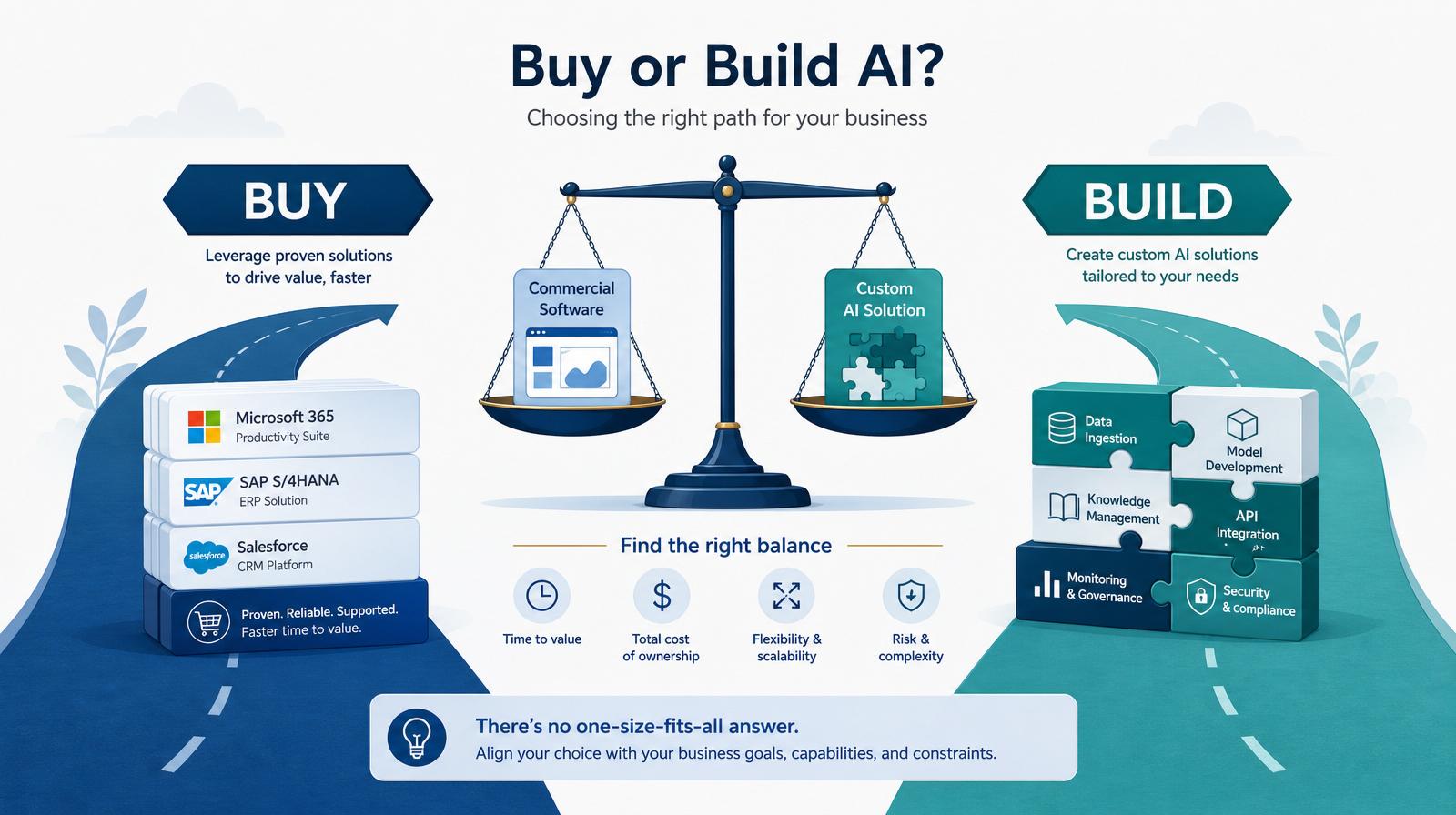
A Simple Decision Framework
If I had to summarise the entire article into one framework, it would be this:
Buy when...
- The process is common.
- Excellent commercial software already exists.
- The software doesn't differentiate your organisation.
- Configuration meets your needs.
- Integration is straightforward.
Build when...
- The process creates competitive advantage.
- Existing software requires constant workarounds.
- The workflow is unique.
- Employees spend significant time performing repetitive specialist work.
- AI can strengthen expertise rather than replace it.
Combine both when...
- Commercial software provides the foundation.
- Custom AI enhances your unique workflows.
- Integration creates the greatest value.
For most organisations, this hybrid approach delivers the best long-term outcome.
Competitive Advantage Doesn't Come From AI
This may sound surprising coming from an AI consultancy.
But I genuinely believe it's true.
Competitive advantage doesn't come from owning AI.
It comes from understanding your business better than your competitors.
AI simply allows you to execute that advantage more effectively.
The organisations winning with AI aren't necessarily using more advanced technology.
They're applying it more intelligently.
They're investing where it creates measurable business value.
And they're avoiding unnecessary complexity everywhere else.
Key Takeaways
- Buying software is often the smartest business decision.
- Custom AI should be reserved for workflows that genuinely differentiate your organisation.
- The objective is business value—not software ownership.
- AI is most powerful when it strengthens existing expertise.
- A hybrid approach usually provides the greatest long-term return.
- Good investment decisions matter more than owning the latest technology.
Before You Decide Whether To Buy Or Build
One question is worth answering first:
Are you solving the right problem?
Many organisations spend weeks evaluating software before they've fully understood where AI can create the greatest value.
That's why we usually begin with an AI Readiness Assessment.
It evaluates:
- Your business priorities
- Existing processes
- Operational bottlenecks
- Data and knowledge maturity
- Technology landscape
- Governance
- AI opportunities
The outcome isn't a recommendation to build software.
It's a recommendation to make the right investment.
Sometimes that's custom AI.
Sometimes it's an existing platform.
Sometimes it's improving a process before introducing AI at all.
The objective is always the same:
Helping organisations make better decisions.
Continue The Conversation
At IntelliMinds Digital, we help organisations decide what should be bought, what should be built, and where AI creates genuine competitive advantage.
Our services include:
- AI Readiness Assessments
- AI Strategy Consulting
- AI Opportunity Discovery
- Custom AI Development
- AI Automation
- Prototype to Production
- Managed AI Hosting & Long-term Support
Because successful AI isn't measured by how much software you own.
It's measured by the business outcomes you achieve.
Relevant Services
- AI Readiness Assessment — structured diagnostic of strategy, data, technology, governance and people.
- AI Strategy Consulting — decide where AI investment will and will not pay back.
- Custom AI Development — build the AI workflow, tightly fitted to how your business actually operates.
- Prototype to Production — take a working prototype to a secure, monitored production system.
- Managed AI Hosting — ongoing operation, monitoring and improvement of live AI systems.
Author
Vikram Katyani — Founder, IntelliMinds Digital.
Helping organisations make better AI investment decisions by combining practical strategy, enterprise software experience and production-ready AI delivery. Every engagement starts with the business problem—not the technology.