AI Doesn’t Fail Because of Technology
Every week, organisations announce ambitious new AI initiatives. Some are investing in generative AI. Some are building internal knowledge assistants. Others are automating proposals, customer support, HR processes or software development.
Yet despite unprecedented investment, most AI initiatives fail to deliver the business value leaders expect. Industry research consistently suggests that well over half of AI projects either fail completely or never progress beyond isolated pilots. Even projects that reach production often struggle to achieve meaningful adoption or measurable return on investment.
Interestingly, these failures rarely stem from poor technology. Modern AI platforms are more capable than ever. Large language models continue to improve. Development tools such as Lovable, Cursor and Bolt have dramatically reduced the time needed to build working prototypes. Cloud infrastructure has never been easier to deploy. The technology itself is no longer the biggest obstacle.
The real challenge lies elsewhere. Successful AI programmes depend on organisational readiness. Before an organisation asks: “Which AI platform should we use?” it should first ask: “Are we actually ready to succeed with AI?” That single question often determines whether AI becomes a competitive advantage—or an expensive experiment.
The Mistake Most Organisations Make
Many organisations begin their AI journey by evaluating technology. They arrange product demonstrations. They compare vendors. They request quotations. They debate whether they should build a bespoke solution or purchase an existing platform. These are sensible conversations—but they happen far too early.
Choosing technology before understanding organisational readiness is similar to selecting construction materials before deciding whether the ground is stable enough to build upon. The technology may be excellent. The implementation may be flawless. But if the foundations are weak, the project will eventually struggle.
Over the past year, I’ve spoken with organisations across learning, professional services, engineering, sales, customer support and operations. Although their industries differ considerably, the early conversations are remarkably similar:
- “We think AI could help us.”
- “We’ve seen some interesting demonstrations.”
- “Our competitors are talking about AI.”
- “We know we should be doing something.”
Those are perfectly reasonable starting points. However, they rarely answer the questions that truly determine success. Questions such as:
- Which business problems actually deserve AI?
- Is our data reliable enough?
- Which teams are ready to adopt new ways of working?
- Who will own the solution after implementation?
- How will we measure success?
- What happens when the AI produces incorrect answers?
- Are our governance processes ready?
- Can we support this system twelve months from now?
Without answering these questions first, organisations often invest significant time and budget solving problems that were never technical to begin with. This is precisely the pattern explored in our companion guide, Why Most AI Projects Fail Before They Deliver Business Value.
AI Readiness Is About the Organisation—Not the Technology
One of the biggest misconceptions surrounding AI is that readiness is primarily a technical concept. It isn’t. Technology is only one component. An organisation may possess outstanding infrastructure yet still fail with AI because its processes are poorly defined. Another organisation may have excellent data but lack executive sponsorship. Others may have enthusiastic leadership but insufficient governance. Some may simply choose the wrong business problem to solve.
AI Readiness examines the organisation as a whole. It asks whether the business possesses the necessary foundations to adopt AI successfully—not just today, but sustainably over the coming years. That means considering questions such as:
- Do leaders agree on why AI is being introduced?
- Are employees prepared for changes in the way they work?
- Are existing business processes sufficiently mature?
- Can current data support reliable decision-making?
- Are security and governance appropriate?
- Is there a realistic operational plan after deployment?
Notice that none of these questions involve selecting a software platform. That is entirely deliberate. Technology should support organisational strategy—not define it.
Why AI Is Different from Previous Technology Projects
Many executives naturally compare AI initiatives with previous software implementations. Perhaps they’ve introduced an LMS. Migrated to Microsoft 365. Implemented CRM software. Upgraded an ERP platform. Those projects certainly involve change. However, AI introduces a fundamentally different challenge.
Traditional software generally follows predetermined rules. AI systems generate outputs based on probability, context and evolving information. That means organisations must become comfortable managing uncertainty. Successful AI programmes require continuous monitoring, ongoing evaluation, governance, human oversight, operational ownership and regular improvement.
In other words, AI behaves less like software purchased once and more like a capability that matures over time. This is one of the reasons why many AI demonstrations appear far more impressive than long-term production systems. Building AI has become remarkably easy. Operating AI successfully remains difficult—a point we explore in depth in AI Applications Aren’t “Build Once, Run Forever”.
The Cost of Starting Too Early
One of the most expensive assumptions organisations make is believing that beginning quickly automatically creates competitive advantage. In reality, rushing often delays progress.
Consider two hypothetical organisations. Organisation A immediately purchases an AI platform because leadership fears falling behind competitors. The technology works exactly as promised. However, data quality proves inconsistent. Business processes differ between departments. Employees receive little guidance. No one clearly owns the system after launch. Six months later, usage declines dramatically. The software wasn’t the problem. The organisation simply wasn’t ready.
Organisation B begins differently. Leadership first assesses organisational readiness. They identify high-value opportunities. They improve critical data sources. They establish governance. They agree success measures. Only then do they select appropriate technology. Implementation takes slightly longer. Yet eighteen months later the organisation has multiple AI solutions operating successfully because the foundations were established first.
The difference wasn’t technical expertise. It was preparation. That preparation is what this guide calls AI Readiness.
The IntelliMinds AI Readiness Framework™
At IntelliMinds Digital, we’ve found that successful AI initiatives rarely depend on choosing the perfect technology. Instead, they depend on whether the organisation is ready to adopt AI as a capability.
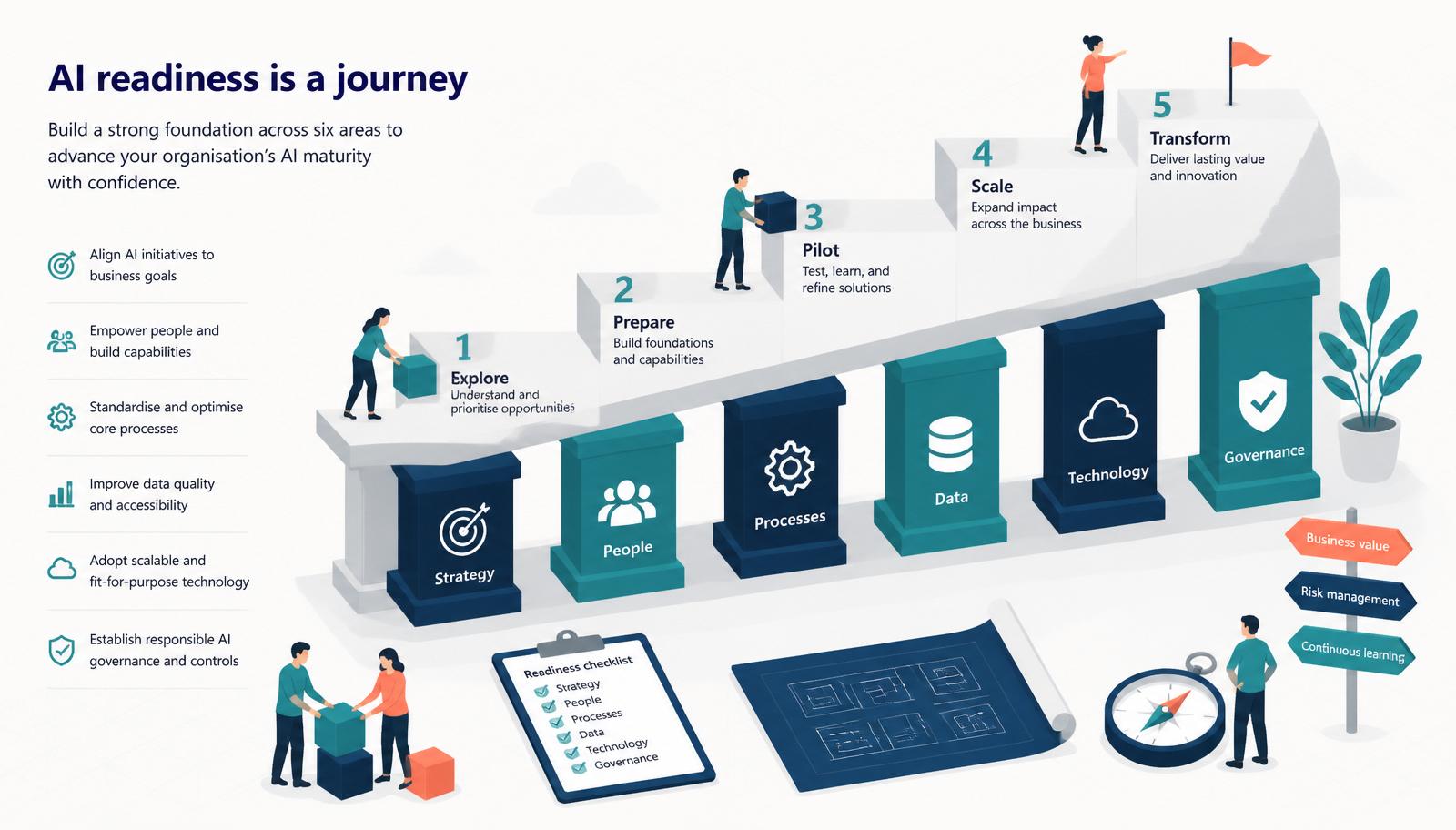
Over time, we’ve observed that organisations consistently succeed when six areas mature together. Weakness in any one of these areas can slow progress, increase risk or prevent AI from delivering meaningful business value. We call these six areas the IntelliMinds AI Readiness Framework™. Rather than viewing AI as a technology project, this framework encourages leaders to evaluate AI as an organisational capability. Every AI Readiness Assessment delivered by IntelliMinds is built around these six pillars.
The Six Pillars of AI Readiness
1Strategy
Everything begins with clarity. Many organisations say they want to “use AI.” Far fewer can clearly explain why, for which business outcomes, or against which priorities. Technology should never become the strategy. Instead, strategy should determine where AI creates measurable value.
Leaders should ask: Which strategic objectives could AI accelerate? Which problems are genuinely worth solving? How will success be measured? Which initiatives deserve priority? Strong AI programmes begin with business objectives—not software demonstrations.
2People
Technology rarely fails because employees resist change. People resist uncertainty. Introducing AI changes decision making, workflows, responsibilities, confidence and expectations. Employees naturally ask: “Will AI replace me?” “Can I trust it?” “What happens if it’s wrong?”
Organisations that succeed invest in communication, training, transparency, practical education and leadership engagement. AI adoption is ultimately a people programme.
3Processes
Poor processes become poor AI. If existing workflows are inconsistent, undocumented or heavily dependent upon individual knowledge, AI simply automates confusion. Before introducing AI, organisations should examine process maturity, standardisation, ownership, approval stages and exception handling.
One of the simplest questions leaders can ask is: “If two experienced employees complete this task today, do they follow the same process?” If the answer is no, AI is unlikely to solve the problem.
4Data
Every AI conversation eventually reaches data. Not because AI requires perfect data. But because AI amplifies whatever information already exists. Reliable AI depends upon accessible information, accurate records, trusted knowledge, consistent terminology and well-managed documents.
Many organisations discover that their biggest AI project is not building AI at all—it’s improving the information AI relies upon. Good data doesn’t guarantee successful AI. Poor data almost guarantees disappointing AI.
5Technology
Technology still matters. It simply isn’t the starting point. Only after understanding business priorities should organisations evaluate existing platforms, integrations, security, infrastructure, scalability, hosting and support requirements.
The question changes from “Which AI tool looks most impressive?” to “Which technology best supports our objectives?” This subtle shift prevents many expensive mistakes—including the classic build-versus-buy dilemma explored in Should You Build Custom AI or Buy Off-the-Shelf AI?
6Governance
Perhaps the most overlooked pillar. Who owns the AI? Who monitors it? Who approves changes? How are risks managed? How are incorrect responses handled? How are regulations addressed?
Governance transforms AI from an interesting experiment into an operational business capability. Without governance, organisations often find themselves asking difficult questions only after problems arise. Strong governance answers those questions before implementation begins.
Why the Six Pillars Must Work Together
One of the biggest mistakes organisations make is strengthening only one pillar. For example: excellent technology, poor governance. Or outstanding leadership enthusiasm, weak data. Or reliable processes, no employee engagement. AI succeeds through balance.
Imagine a six-legged table. Each leg represents one readiness pillar. If one leg is significantly shorter than the others, the entire table becomes unstable. Improving only one area rarely solves the underlying problem. Instead, organisations should gradually strengthen every pillar together. This is precisely what an AI Readiness Assessment is designed to reveal.
Readiness Is Not the Same as AI Maturity
These two concepts are often confused. They are related—but different.
AI Readiness asks: “Could we successfully begin an AI initiative?” It measures preparedness. AI Maturity asks: “How advanced is AI within our organisation today?” It measures progress.
An organisation may have low AI maturity but high readiness—they possess strong leadership, reliable data, clear governance and excellent processes; they simply haven’t yet begun implementing AI. Conversely, another organisation may appear highly mature because multiple AI tools are already deployed. Yet they suffer from poor governance, unclear ownership, weak adoption and fragmented processes. In reality, they may be less prepared for long-term success than organisations with fewer AI solutions.
Understanding this distinction helps leaders avoid chasing visible innovation while neglecting sustainable foundations.
The Five Levels of AI Maturity
Not every organisation begins its AI journey from the same place. Some have never experimented with AI. Others have enthusiastic employees already using public AI tools without formal governance. Some have launched successful pilots but struggle to scale them across the business. A small number have successfully embedded AI into everyday operations.
Recognising where your organisation sits today is essential because every stage demands different priorities. Attempting to accelerate too quickly often creates frustration rather than progress. Instead of asking “How quickly can we deploy AI?”, successful organisations ask “What is the next logical step for our organisation?” That shift in thinking transforms AI from a technology race into a business capability that grows steadily over time.
1Curious
The organisation recognises AI’s potential but has little structured activity. Employees may already be experimenting individually, but there is no coordinated strategy. Primary objective: understand organisational readiness before investing.
2Exploring
Leadership has committed to investigating AI opportunities. Workshops begin. Departments identify possible use cases. This is also the stage where organisations are most vulnerable to buying technology before defining business priorities. Primary objective: identify the highest-value opportunities.
3Experimenting
Pilot projects begin. Teams develop proof-of-concepts. Small AI assistants emerge. This is where many organisations become stuck: pilots demonstrate possibility but rarely address governance, ownership, monitoring, security or operational support. Primary objective: prepare successful pilots for production.
4Operational
AI now supports real business processes. Employees trust the systems. Governance exists. Performance is monitored. Business value becomes measurable. Leadership begins viewing AI as part of normal operations rather than innovation. Primary objective: expand responsibly while maintaining quality.
5AI-Enabled Organisation
AI becomes embedded across multiple business functions. Departments continuously identify new opportunities. Governance evolves alongside technology. Leadership no longer asks “Should we use AI?” but “Where can AI create our next competitive advantage?” At this stage AI becomes part of organisational culture rather than a separate initiative.
Maturity Is Not a Competition
Higher maturity is not automatically better. Every organisation should progress at a pace appropriate to its readiness. A manufacturing business with limited digital maturity should not compare itself with a global technology company. The objective is not to reach Level 5 quickly—it is to move confidently from one level to the next. Sustainable progress almost always outperforms rapid but unstable implementation.
Identifying High-Value AI Opportunities
Once organisations understand their readiness and maturity, the next challenge becomes choosing where to begin. This is where many AI programmes lose momentum. Teams generate dozens of ideas. Very quickly the organisation accumulates a long list of possibilities. The problem is no longer a shortage of ideas—it’s deciding which ideas deserve investment.
One of the simplest mistakes organisations make is asking “Where can we use AI?” Instead they should ask “Where can AI create measurable business value?” These are very different questions. Our companion guide, How to Identify High-Value AI Opportunities, explores this framework in depth.
Four Questions That Prioritise Opportunities
1Does this solve a meaningful business problem?
Interesting technology is not enough. The opportunity should address a genuine operational challenge—reducing proposal preparation time, improving customer response quality, eliminating repetitive administration, accelerating internal knowledge retrieval. If solving the problem would not materially improve the organisation, AI is probably unnecessary.
2Is the process repeated frequently?
AI delivers its greatest value when supporting work that happens regularly. Processes performed hundreds or thousands of times each year usually produce stronger returns than highly specialised one-off activities. Frequency often matters more than complexity.
3Is reliable information available?
Every AI system depends upon context. Without reliable documents, structured knowledge or trusted data, even the best AI models struggle to produce consistent results. Many promising ideas fail simply because the information foundation is incomplete.
4Can success be measured?
Every AI initiative should define success before development begins. Possible measures include time saved, revenue increased, proposals completed, support requests resolved, employee satisfaction and customer experience improvements. If success cannot be measured, leadership will struggle to justify continued investment.
Avoiding the “Shiny Object” Trap
Generative AI evolves at extraordinary speed. Every month introduces new models, new platforms, new assistants and new demonstrations. It is easy for leadership teams to become distracted by the latest announcement. However, competitive advantage rarely comes from adopting the newest model first. It comes from consistently solving important business problems.
Technology changes rapidly. Business priorities usually change much more slowly. The organisations creating lasting value remain focused on their business objectives while allowing technology to evolve around them.
From AI Pilot to Business Capability
One of the biggest misconceptions surrounding AI is that building a working prototype represents the hardest part of the journey. In reality, building the prototype is often the easiest stage. Modern development tools allow organisations to create impressive AI demonstrations within days.
A proof of concept can answer questions. A prototype can impress stakeholders. A pilot can generate excitement. None of these, however, guarantee long-term business value. The real challenge begins after the demonstration. This is the transition explored in detail in our companion guide, From Prototype to Production.
The “Prototype Trap”
Many organisations unknowingly fall into what we call the Prototype Trap. A department builds an AI assistant. The demonstration is impressive. Leadership approves further investment. Employees begin using it. Then reality arrives.
Questions emerge that were never considered during development. Who owns the application? Who updates prompts? Who monitors performance? How are incorrect answers corrected? What happens when the business process changes? Who manages hosting? Who performs backups? Who responds if the AI stops working? Suddenly the technical demonstration becomes an operational responsibility. Unfortunately, many organisations discover they planned for the prototype—but not for production. (For a practical view from inside the engineering room, see Built an AI App in Lovable? Here’s What It Really Takes to Run It in Production.)
Production Is an Operating Model
Moving AI into production is not simply a deployment exercise. It requires an operating model. Successful organisations establish clear ownership across several areas:
- Business Ownership — someone accountable for the business outcome, not the technology.
- Technical Ownership — someone managing hosting, security, integrations, monitoring, updates and performance.
- Operational Ownership — ensuring the AI evolves as documents, policies, products and processes change.
- Governance Ownership — continuous oversight of risk, compliance, privacy, auditability and acceptable use.
AI Is Never Finished
One difference separates AI from traditional software. Traditional software often reaches a stable state. AI rarely does. Knowledge changes. Processes improve. Business priorities evolve. Customers ask different questions. Large language models continue advancing. An AI solution that performs brilliantly today may require adjustments six months later. This is not failure—it is simply the nature of AI.
The most successful organisations accept that AI is a living capability. They continuously monitor accuracy, usage, adoption, business outcomes and employee feedback. They refine systems continuously rather than treating implementation as the finish line.
The Twelve-Month Executive Roadmap
Every organisation progresses differently. However, successful AI programmes often follow a similar pattern. This roadmap is a companion to How to Introduce AI Into Your Organisation, which explores the change-management side in depth.
Months 1–2 — Understand
Conduct an AI Readiness Assessment. Identify organisational strengths and gaps. Establish executive sponsorship. Prioritise opportunities. Outcome: clarity.
Months 3–4 — Design
Select one or two high-value initiatives. Improve data quality. Define governance. Agree success measures. Prepare change management. Outcome: a realistic implementation plan.
Months 5–7 — Build
Develop initial AI solutions. Validate with users. Improve prompts. Test workflows. Measure early outcomes. Outcome: working pilot.
Months 8–10 — Operate
Move into production. Establish monitoring. Train employees. Document ownership. Measure adoption. Outcome: reliable operational capability.
Months 11–12 — Scale
Review lessons learned. Expand into additional departments. Standardise governance. Develop internal AI capability. Create continuous improvement processes. Outcome: organisation-wide confidence.
Scaling AI Responsibly
Many organisations assume scaling means building more AI. It doesn’t. Scaling means making AI sustainable. Before expanding into additional departments, leaders should ask: Have existing solutions delivered measurable value? Are employees confident using them? Is governance functioning effectively? Can current support processes handle additional systems? If the answer is no, scaling should wait. Expanding weak foundations simply multiplies problems. Strong organisations scale after stability—not before.
The Leadership Mindset
Perhaps the biggest change executives must make is shifting their perception of AI. AI is not another software purchase. It is not another digital transformation project. It is a new organisational capability. Capabilities require leadership, investment, ownership, measurement and continuous improvement.
When leadership embraces this mindset, conversations change. Instead of asking “Which AI platform should we buy next?” they begin asking “How do we continuously improve the way our organisation uses AI?” That is the point where AI stops being an initiative. It becomes part of how the organisation operates.
Success Is Measured Differently
The success of an AI programme should never be measured by number of pilots, number of chatbots, number of licences or number of models deployed. Instead, measure outcomes such as time returned to employees, customer experience improvements, proposal turnaround time, reduced operational effort, knowledge accessibility, decision quality and employee confidence. Business value—not technology—remains the ultimate measure of success.
Executive Checklist
Before investing in any AI initiative, every leadership team should be able to answer the following questions confidently.
Strategy
- Have we clearly defined the business problems we want AI to solve?
- Do these problems align with our organisational objectives?
- Have we prioritised opportunities based on measurable business value?
People
- Have we prepared employees for changes in the way they will work?
- Is leadership visibly supporting AI adoption?
- Do employees understand where AI helps—and where human judgement remains essential?
Processes
- Are the processes we intend to automate clearly documented?
- Are they already reasonably consistent across the organisation?
- Have we removed unnecessary complexity before introducing AI?
Data
- Is the information AI will use accurate and trusted?
- Can employees easily access the knowledge required?
- Have we identified gaps in data quality?
Technology
- Do our existing systems support AI integration?
- Have we considered hosting, monitoring, security and scalability?
- Are we selecting technology because it solves a business problem—not simply because it is new?
Governance
- Who owns the AI solution?
- Who maintains it?
- Who monitors performance?
- How will risks be managed?
- How will the solution improve over time?
If several of these questions remain unanswered, the organisation should focus on improving readiness before investing heavily in AI development.
Five Leadership Questions Worth Discussing
Technology discussions often dominate AI conversations. Leadership discussions should focus elsewhere. These five questions regularly produce the most valuable conversations during executive workshops.
1Which business outcomes would make AI genuinely worthwhile for our organisation?
Not interesting. Not impressive. Worthwhile.
2If AI disappeared tomorrow, which business problems would still deserve solving?
Those are usually the best candidates for AI investment.
3What information would AI rely upon—and how much do we trust it today?
Most AI projects succeed or fail long before the first prompt is written.
4Who will own AI after implementation?
Projects need owners. Capabilities need long-term stewardship.
5If this AI initiative succeeds, what changes for our organisation?
If leadership cannot describe the future business outcome clearly, the initiative probably needs further refinement.
The Organisations That Will Benefit Most from AI
Over the coming years, AI will undoubtedly transform how organisations operate. However, the biggest winners will not necessarily be those using the most advanced models. They will be organisations that consistently make better decisions about where—and how—to apply AI. They will identify valuable opportunities, prepare employees, improve processes, strengthen governance and build reliable operational capability.
AI becomes a multiplier. It amplifies whatever already exists. Strong organisations become stronger. Weak foundations become more visible. That is why readiness matters.
AI Is a Journey—Not a Project
Perhaps the most important message from this guide is that AI should not be viewed as a single implementation project. It is an organisational capability—like leadership, like customer service, like innovation. Capabilities grow over time. They mature through experience. They improve through continuous learning.
The organisations creating long-term competitive advantage will not be those that implemented AI first. They will be those that continue improving how AI supports their people, customers and operations.
Where to Begin
Many organisations ask us: “Where should we start?” The answer is rarely “Build an AI assistant.” Instead, we recommend beginning with three simple steps.
1Understand your organisation’s current level of readiness
Identify strengths. Identify gaps. Understand where investment will create the greatest value.
2Prioritise one or two meaningful business problems
Avoid trying to transform everything at once. Small, successful initiatives create confidence. Confidence creates momentum. Momentum creates transformation.
3Build sustainably
Think beyond demonstrations. Plan for governance, support, monitoring and continuous improvement. The objective isn’t simply launching AI. The objective is creating lasting business capability.
How the IntelliMinds AI Readiness Assessment Helps
Every organisation’s journey is different. The purpose of the IntelliMinds AI Readiness Assessment is not to recommend technology. It is to help leadership understand where they are today and what should happen next. The assessment evaluates your organisation across the six pillars introduced in this guide: Strategy, People, Processes, Data, Technology and Governance.
You’ll receive:
- An overall AI Readiness Score
- Scores for each of the six pillars
- A personalised maturity assessment
- Priority recommendations
- A practical roadmap for improving readiness
- Suggested AI opportunities aligned to your organisation
The assessment is designed to help leadership make confident decisions before significant investment begins.
Continue Your Learning
This Executive Guide forms the foundation of the IntelliMinds knowledge library. You may also find these Executive Guides useful:
- Why Most AI Projects Fail Before They Deliver Business Value
- How to Identify High-Value AI Opportunities Inside Your Organisation
- Should You Build Custom AI or Buy an Off-the-Shelf AI Tool?
- Built an AI App? Here’s What It Really Takes to Run It in Production
- AI Applications Aren’t “Build Once, Run Forever”
- How to Introduce AI Into Your Organisation Without Disrupting the Business
Each explores one stage of the AI journey in greater depth.
Final Thoughts
Artificial Intelligence is often presented as a race. A race to adopt the newest models. A race to automate more work. A race to build faster than competitors. In reality, sustainable competitive advantage rarely comes from moving fastest. It comes from moving with purpose.
Organisations that understand their readiness, strengthen their foundations and implement AI thoughtfully will almost always outperform those chasing technology without a clear strategy. At IntelliMinds Digital, we believe successful AI is never about replacing people. It is about helping capable people make better decisions, work more effectively and focus on the activities where human expertise creates the greatest value.
Technology changes rapidly. Strong organisations endure. Build the organisation first. The technology will follow.
About the Author
Vikram Katyani is the Founder of IntelliMinds Digital, where he helps organisations move from AI curiosity to measurable business outcomes. His work focuses on AI strategy, AI readiness, custom AI development, prototype-to-production engineering and the long-term operation of AI systems in real business environments.