Introduction
For decades, organisations have treated software projects in roughly the same way.
Requirements are gathered.
The application is designed.
Development takes place.
Testing follows.
The software goes live.
The project ends.
There may be occasional updates or bug fixes, but fundamentally the application is considered complete.
AI changes that model entirely.
Unlike traditional software, AI systems continue evolving long after deployment.
The language models improve.
Providers introduce new capabilities.
Pricing changes.
Business processes evolve.
Users discover better ways of working.
Even the questions people ask the system change over time.
In other words, an AI application is never really "finished."
It's a living business capability.
That shift has profound implications for organisations beginning to adopt AI.
The Old Software Mindset
Traditional software behaves predictably.
If you build an expense approval system, it performs the same task today that it performed last month.
The business rules remain relatively stable.
Updates are planned.
Changes are controlled.
Users expect consistency.
AI applications behave differently.
Although the surrounding software remains predictable, the intelligence inside the application continues changing.
Large language models receive updates.
New models become available.
Prompt strategies improve.
Retrieval techniques evolve.
Security guidance changes.
Entirely new capabilities appear.
The pace of change is unlike anything most organisations have experienced before.
That creates tremendous opportunity.
It also creates new operational responsibilities.
AI Doesn’t Stand Still
Imagine deploying an AI-powered knowledge assistant today.
Six months later:
A faster model becomes available.
Inference costs have reduced significantly.
Context windows are larger.
Response quality has improved.
Your employees have identified better prompts.
Your knowledge base has grown.
New documents require indexing.
User behaviour has changed.
The application still works.
But is it still the best version of itself?
Probably not.
Unlike traditional software, AI systems naturally improve when organisations continue investing in them.
Stopping development immediately after deployment often means missing much of the long-term value.
The Difference Between Maintenance And Improvement
People often hear the phrase "ongoing support" and imagine fixing bugs.
That's only a small part of operating AI successfully.
Support means keeping the application available.
Improvement means making it more valuable.
Those are different activities.
Maintenance includes:
- infrastructure updates
- security patches
- monitoring
- backups
- deployment pipelines
- incident response
Improvement includes:
- refining prompts
- optimising workflows
- introducing new models
- reducing operating costs
- improving response quality
- expanding automation
- learning from user behaviour
Both matter.
One protects the system.
The other increases its business value.
Organisations that understand this distinction tend to realise much greater returns from their AI investments.
The Most Valuable AI Systems Continue Learning
Interestingly, many successful AI applications become more useful over time.
Not because the model magically improves on its own.
Because the organisation learns.
Employees discover new use cases.
Teams identify repetitive tasks worth automating.
Knowledge bases expand.
Business processes become clearer.
New integrations are introduced.
The AI application gradually becomes woven into the organisation's daily operations.
This isn't accidental.
It's the result of continuous improvement.
The organisations creating the greatest value from AI don't simply deploy applications.
They continuously refine them.
Why AI Systems Don’t Age Like Traditional Software
One of the reasons organisations underestimate the operational side of AI is that they're applying lessons learned from traditional software.
For years, software behaved in a predictable way.
Once deployed, the application remained largely unchanged.
Servers received security patches.
The occasional bug was fixed.
Perhaps a new feature was introduced every few months.
But the underlying purpose of the application remained stable.
AI systems don't behave like that.
In fact, one of the biggest risks facing organisations isn't that the application stops working.
It's that the world around it changes.
Business Drift Is Often More Important Than Model Drift
There's growing discussion within the AI community about model drift.
It's an important concept.
But for many organisations, something else creates even greater impact.
Business drift.
Businesses never stand still.
Products change.
Policies evolve.
Teams reorganise.
Customers ask different questions.
Regulations are updated.
Entirely new services are introduced.
If your AI assistant was trained on yesterday's business, it may slowly become less useful—even if the underlying language model remains excellent.
Consider an internal HR assistant.
Six months after deployment:
The company has introduced new policies.
Benefits have changed.
Departments have merged.
Managers have changed.
New compliance requirements have appeared.
The AI hasn't suddenly become "bad."
It's simply answering yesterday's questions with yesterday's knowledge.
That's why maintaining knowledge, workflows and business context is often more valuable than endlessly chasing the newest language model.
Success Creates New Demands
Another interesting pattern appears once an AI application proves successful.
People begin relying on it.
That's good news.
But it also changes expectations.
When only ten people use an internal assistant, occasional issues are tolerated.
When five hundred people depend on it every day, expectations become very different.
Users expect:
- fast responses
- consistent quality
- high availability
- accurate information
- reliable performance
In many organisations, AI quietly shifts from being an innovation project to becoming operational infrastructure.
The expectations become similar to email, Microsoft Teams or the CRM system.
Nobody celebrates those platforms working.
People simply expect them to.
AI eventually reaches the same point.
Every Improvement Creates Another Opportunity
One of my favourite aspects of AI projects is that success tends to reveal the next opportunity.
A proposal-writing assistant reduces the time spent producing first drafts.
Very quickly, someone asks:
"Could it also review compliance requirements?"
Once that's delivered:
"Could it identify missing information?"
Later:
"Could it suggest win themes?"
Eventually:
"Could it integrate directly into our CRM?"
The project hasn't expanded because someone changed the scope.
It's expanded because people have started imagining what's possible.
That's exactly what you want.
AI adoption rarely happens through one enormous transformation.
It grows through a series of practical improvements that build on each other.
Organisations should expect that.
In fact, they should plan for it.
Measuring Value Doesn’t Stop At Go-Live
Many software projects celebrate deployment as the final milestone.
AI projects shouldn't.
Deployment simply marks the beginning of measuring real business value.
Questions now become much more interesting.
Has proposal quality improved?
Are customer queries resolved faster?
Has manual administration reduced?
Are employees actually using the assistant?
Has time been saved?
Are operating costs falling?
Where are people still struggling?
The answers to those questions drive the next iteration.
Without measurement, organisations are simply hoping the AI is helping.
With measurement, they know.
That's a significant difference.
The Cost Of Standing Still
There's another reality that organisations should consider.
Doing nothing has a cost.
Imagine deploying an AI application and leaving it untouched for two years.
The business changes.
The knowledge changes.
Technology advances.
Users develop new expectations.
Meanwhile, competitors continue improving their own systems.
Eventually the application still functions.
But it no longer delivers the value it once did.
Not because it failed.
Because it stopped evolving while everything around it continued moving forward.
That's why I believe organisations should think less about maintaining AI applications and more about stewarding them.
Stewardship implies responsibility.
It recognises that AI systems require ongoing attention—not because they're broken, but because successful businesses never stop changing.
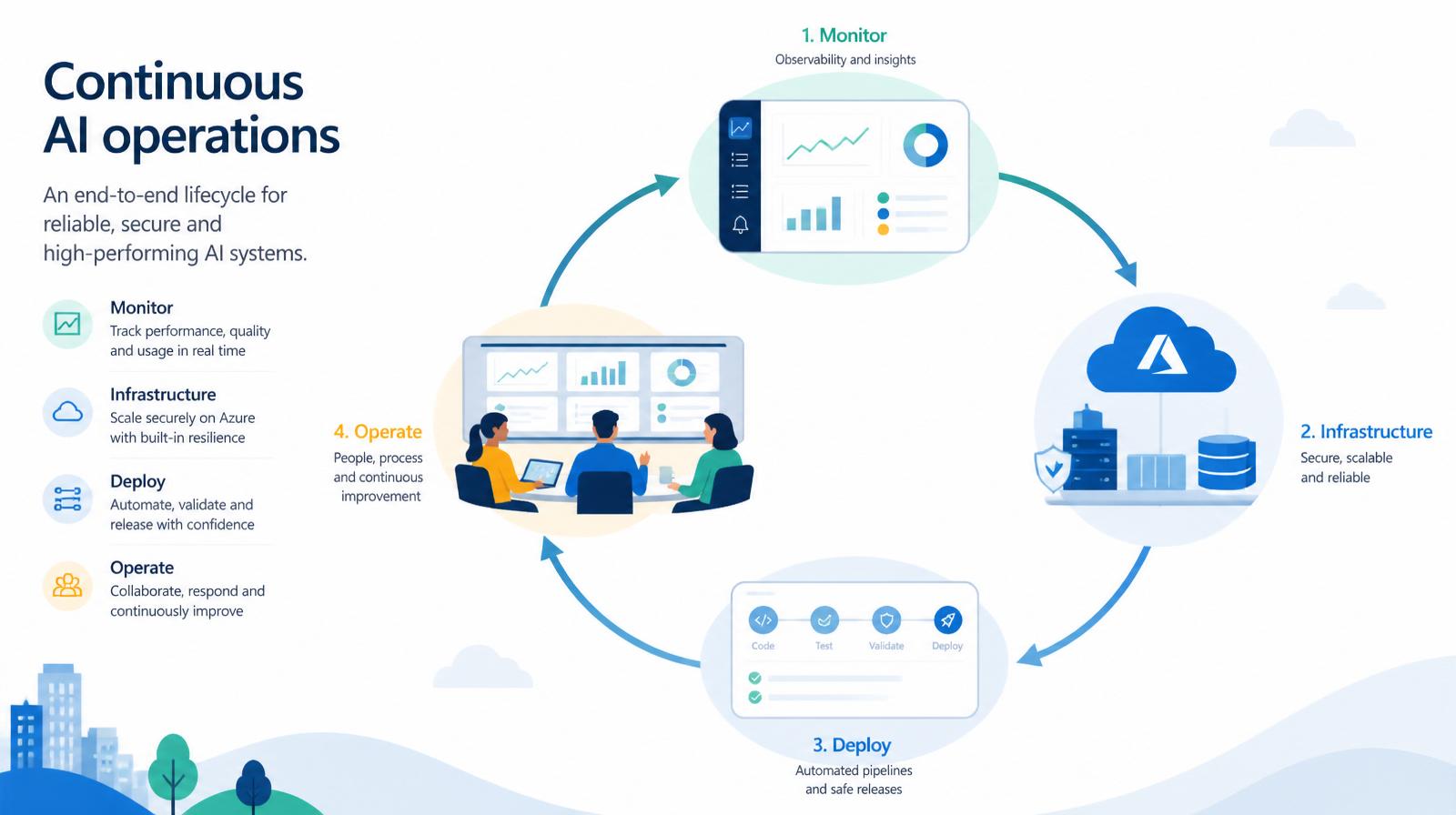
What Good AI Operations Actually Look Like
When people hear the phrase "AI operations," they often imagine a room full of data scientists constantly retraining models.
For most organisations, the reality is far simpler—and far more practical.
Successful AI operations are not about constantly rebuilding the technology.
They're about ensuring the technology continues delivering value safely, reliably and efficiently.
Just as finance teams reconcile accounts and IT teams monitor infrastructure, AI systems need routine operational care.
The organisations seeing the greatest return from AI are the ones that make this care part of normal business operations.
Monitoring More Than Uptime
Traditional application monitoring focuses on availability.
Is the website online?
Are servers responding?
Is the database healthy?
Those questions still matter.
But AI introduces an entirely new layer of monitoring.
For example:
- Are responses still accurate?
- Are users receiving useful answers?
- Has response quality changed?
- Are costs increasing unexpectedly?
- Is usage growing?
- Which workflows are creating the most value?
- Where are users abandoning the process?
An AI application can be technically healthy while delivering poor business outcomes.
Equally, it may continue generating excellent responses while operating at twice the expected cost.
Neither issue would appear in a traditional infrastructure dashboard.
That's why AI monitoring combines technical health with business performance.
Both matter equally.
Governance Should Enable Innovation
Governance sometimes receives an unfair reputation.
People hear the word and imagine bureaucracy.
Approvals.
Committees.
Slower projects.
Good governance should achieve the opposite.
Its purpose is to give organisations confidence to move faster.
When responsibilities are clearly defined...
When data handling is understood...
When access controls are established...
When approval processes are proportionate...
...teams spend less time debating risk and more time creating value.
Governance isn't about restricting AI.
It's about ensuring AI can be adopted responsibly across the organisation.
Done well, it becomes an accelerator rather than an obstacle.
Security Is Never Finished
Cybersecurity isn't a one-time exercise.
Neither is AI security.
Threats evolve.
Software dependencies change.
Cloud platforms introduce new capabilities.
Access requirements shift as teams grow.
Third-party services release updates.
An AI application handling sensitive information should be reviewed regularly—not because something has gone wrong, but because the environment around it never stands still.
Simple activities such as reviewing permissions, rotating secrets, validating integrations and checking audit logs become part of routine operational practice.
The objective isn't perfection.
It's resilience.
Managing Cost Without Sacrificing Quality
One topic receiving increasing attention is AI operating cost.
Early prototypes rarely worry about optimisation.
The objective is proving the concept.
Production introduces a different conversation.
Can we maintain quality while reducing cost?
Often, the answer is yes.
For example:
Choosing a smaller model for straightforward tasks.
Using larger models only where genuinely necessary.
Improving prompts to reduce unnecessary processing.
Caching common responses.
Optimising retrieval strategies.
Monitoring token consumption.
None of these changes alter the user's experience.
But collectively they can significantly reduce operational expenditure while maintaining—or even improving—quality.
Cost optimisation should therefore be viewed as continuous improvement rather than cost cutting.
Listening To Users
Perhaps the most valuable source of improvement isn't technical data.
It's user feedback.
Employees quickly discover:
where the AI performs well.
where responses could improve.
which tasks remain frustrating.
which manual steps still exist.
Those insights are incredibly valuable because they come from people using the system every day.
Unfortunately, many organisations collect feedback during development and stop listening after deployment.
The opposite approach usually produces better outcomes.
Deployment should increase feedback—not reduce it.
Every conversation with users reveals another opportunity to improve the experience.
The best AI applications aren't built entirely by development teams.
They're shaped collaboratively by the people who depend on them every day.
Continuous Improvement Is A Business Habit
One characteristic appears repeatedly in organisations that gain the greatest value from AI.
They never assume today's version is the final version.
Instead, they establish a simple rhythm.
Measure.
Learn.
Improve.
Repeat.
Sometimes improvements are technical.
Sometimes they're operational.
Sometimes they're surprisingly small.
A better prompt.
A clearer workflow.
A new integration.
A simplified approval step.
Individually these changes may appear insignificant.
Collectively they transform how effectively the organisation uses AI.
That's why continuous improvement should never be viewed as additional work.
It's simply the operational discipline that allows AI to remain valuable long after the excitement of the initial launch has passed.
From IT Support To AI Stewardship
Many organisations already understand the importance of supporting business-critical systems.
What AI introduces is a broader responsibility.
Not simply maintaining infrastructure.
But stewarding an evolving business capability.
That means balancing:
- technology
- people
- governance
- business objectives
- operational performance
It's a much broader role than traditional application support.
And it's becoming one of the defining capabilities of organisations successfully adopting AI.
The businesses that thrive over the coming years won't necessarily be those deploying the most AI applications.
They'll be the ones operating those applications with consistency, confidence and discipline.
That's where sustainable competitive advantage begins.
Five Habits Of Organisations That Get Long-Term Value From AI
After working with organisations delivering enterprise software for more than two decades—and more recently helping businesses deploy AI into production—I've noticed a consistent pattern.
The organisations that generate the greatest return from AI don't necessarily build the most sophisticated applications.
They build the strongest operational habits.
Technology matters.
But habits determine whether that technology continues creating value year after year.
Here are five habits I see repeatedly.
1. They Measure Outcomes, Not Activity
Successful organisations don't measure AI by asking:
"How many AI applications have we built?"
Instead they ask:
- Has response time improved?
- Have proposal win rates increased?
- Has manual effort reduced?
- Are employees saving time?
- Are customers receiving better service?
- Has operational cost fallen?
Those are business outcomes.
They're measurable.
And they provide a far better indication of success than simply counting deployments.
2. They Continue Investing After Go-Live
Deployment isn't viewed as the finish line.
It's viewed as the start of learning.
Once real users begin interacting with the system, organisations gain insights they simply couldn't have discovered during development.
Every month presents opportunities to:
- improve prompts
- streamline workflows
- automate additional tasks
- connect new systems
- improve governance
- optimise operating costs
That ongoing investment compounds over time.
Small improvements made consistently often outperform one large redesign every few years.
3. They Build Confidence Across The Organisation
AI adoption isn't purely a technology challenge.
It's a people challenge.
Employees need confidence that the system is trustworthy.
Managers need confidence that decisions remain visible.
Leadership needs confidence that risks are understood.
Customers need confidence that their information is handled responsibly.
Building that confidence requires communication, transparency and good governance just as much as technical capability.
The organisations that invest in trust generally achieve much higher adoption than those focusing only on functionality.
4. They Expect Technology To Change
The AI landscape evolves continuously.
New foundation models appear.
Existing models improve.
Pricing changes.
Cloud platforms release new capabilities.
Open-source innovation accelerates.
Successful organisations don't try to predict every change.
Instead they design systems that can evolve alongside the technology.
That flexibility becomes a competitive advantage.
Rather than fearing change, they build architectures and operating practices that allow change to happen safely.
5. They Treat AI As Part Of Normal Business Operations
Eventually the conversation stops being about AI.
The technology simply becomes another part of everyday work.
Employees no longer describe themselves as "using AI."
They're simply completing tasks more effectively.
That's probably the strongest indicator of success.
When AI disappears into the background, the business benefits move into the foreground.
That's when organisations know they've moved beyond experimentation.
A Practical AI Operations Health Check
If your organisation already has one or more AI applications in production, ask yourself these questions.
Business
- Are we measuring business outcomes rather than technical metrics?
- Do we know where AI is creating the greatest value?
- Is someone responsible for continuous improvement?
Technology
- Are our AI systems monitored?
- Are operating costs reviewed regularly?
- Can we update models safely when needed?
Governance
- Are responsibilities clearly defined?
- Do we understand how sensitive information is handled?
- Are access permissions reviewed regularly?
People
- Are users encouraged to provide feedback?
- Is adoption increasing?
- Do employees trust the outputs they're receiving?
If several of those questions are difficult to answer, the opportunity probably isn't to rebuild the AI application.
It's to strengthen the operational capability surrounding it.
AI Success Is Measured Over Years, Not Weeks
One lesson has become increasingly clear.
Building AI applications is becoming easier every month.
Running them well remains the real challenge.
That's good news.
Because operational excellence isn't determined by whichever organisation has access to the newest model.
It's determined by discipline.
By good engineering.
By thoughtful governance.
By continuous learning.
By staying focused on business outcomes rather than technology for its own sake.
Those capabilities are much harder to copy than software alone.
They become a genuine competitive advantage.
Key Takeaways
- AI applications should be treated as evolving business capabilities rather than completed software projects.
- Operational excellence creates more long-term value than technical novelty.
- Monitoring should include both technical health and business performance.
- Continuous improvement is essential as organisations, users and AI models evolve.
- Governance and trust accelerate adoption when implemented well.
- The most successful organisations don't simply deploy AI—they operate it exceptionally well.
Where Should You Begin?
Whether you're planning your first AI application or already running several in production, one question is worth asking:
Does our organisation have the operational foundations needed to support AI over the long term?
Our AI Readiness Assessment helps answer exactly that.
In around five minutes you'll receive:
- An AI Readiness Score
- An assessment across strategy, people, processes, technology, data and governance
- Priority opportunities for AI adoption
- Potential implementation risks
- Practical recommendations for your next step
It's designed to help organisations move beyond experimentation and build AI capabilities that continue delivering value long after deployment.
Continue The Conversation
At IntelliMinds Digital, we help organisations move from AI experimentation to dependable production systems.
That includes:
- AI Readiness Assessments
- AI Strategy & Roadmaps
- Custom AI Development
- Production Deployment
- Managed AI Hosting
- Long-term Operational Support
Our goal isn't simply to help organisations build AI.
It's to help them build AI capabilities they can rely on every day.
Related Insights
- The Two Questions Every Organisation Should Answer Before Investing in AI
- From Prototype to Production: Why Most AI Projects Stall After the Demo
- Built an AI App in Lovable? Here's What It Really Takes to Run It in Production
- Why Every Organisation Needs an AI Readiness Assessment Before Building AI
Author
Vikram Katyani
Founder, IntelliMinds Digital
Helping organisations move AI from experimentation into production through practical strategy, custom development and managed AI operations.
Relevant Services
- AI Readiness Assessment — structured diagnostic of strategy, data, technology, governance and people.
- AI Strategy Consulting — decide where AI investment will and will not pay back.
- Custom AI Development — build the AI workflow, tightly fitted to how your business actually operates.
- Prototype to Production — take a working prototype to a secure, monitored production system.
- Managed AI Hosting — ongoing operation, monitoring and improvement of live AI systems.
Author
Vikram Katyani — Founder, IntelliMinds Digital.
Helping organisations move AI from experimentation into production through practical strategy, custom development and managed AI operations.