Workflow orchestration
Designs, runs and monitors multi-step processes across teams and systems.
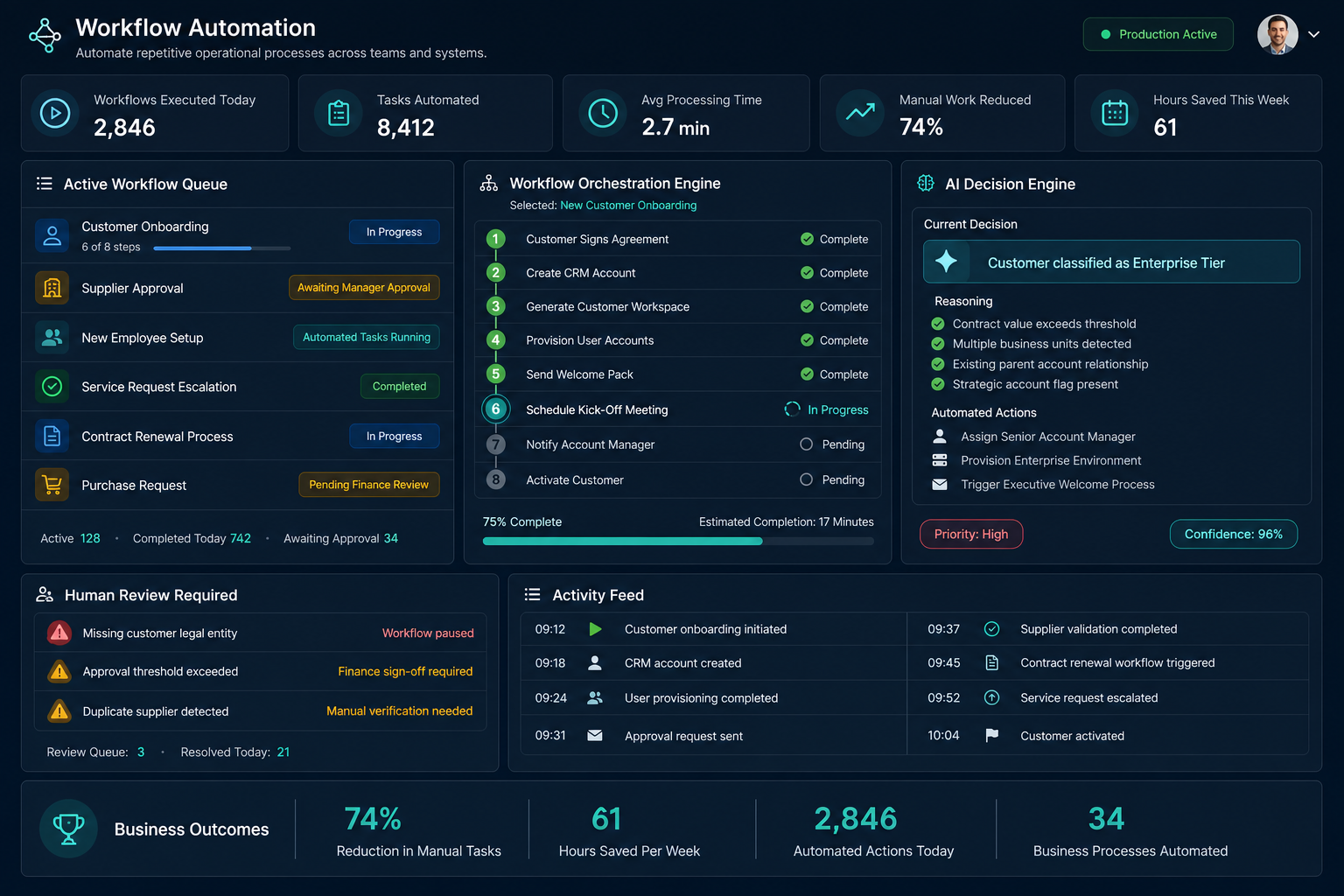
Customer onboarding, supplier approvals, employee setup, service escalations, contract renewals. AI orchestrates the steps, makes the routine decisions and only involves humans when it should.
Most operational processes are workflows in everything but name. Someone receives a request, checks something, updates a system, asks an approver, waits, chases, copies data into another tool, marks it done. Each step makes sense. The end-to-end is slow, inconsistent and invisible.
Classic automation tools handle the easy bits between two systems. They struggle the moment a workflow needs a decision, an exception or context from more than one place.
We build AI-powered workflow platforms that orchestrate end-to-end operational processes — onboarding a customer, approving a supplier, provisioning a new employee, escalating a service request, renewing a contract.
The platform moves work between systems, triggers automated actions, makes routine decisions with an explanation, and pauses for a human only when policy says it should — missing data, exceeded thresholds, anomalies or genuine ambiguity.
The aim isn't a Zapier-style chain of triggers. It's a coordinated workflow that operations leaders can actually see, measure and trust.
From the triggering event to a completed outcome — with AI moving work, making decisions and escalating exceptions.
Trigger event
New customer, ticket, request or approval
Workflow selected
Right process picked from the catalogue
AI decisioning
Tier, priority and routing — with reasoning
Automated actions
CRM, identity, finance and operational systems
Human-in-the-loop
Approvals and exceptions handled in context
Outcome & audit
Completion logged, SLAs and reporting updated
What a production workflow automation platform looks like once it's running operations every day.
Designs, runs and monitors multi-step processes across teams and systems.
Classification, routing and prioritisation with explanations — not a black box.
CRM, ERP, ITSM, identity, finance, HR and bespoke operational tooling.
Approvals, sign-offs and exceptions surfaced with full context to the right person.
A real queue for the edge cases — not a black hole or a manager's inbox.
Throughput, cycle time, exception trends and SLA performance per workflow.
Same operations team. A very different shape of the working day.
Routine workflows run themselves. Cycle times collapse. Operations leaders finally have a real-time view of what's running, what's stuck and where the time is going. People do the work that needs them — not the work a system should have done.
Multi-day processes finish in hours or minutes.
Repetitive steps disappear. Capacity is freed up for higher-value work.
Live view of throughput, bottlenecks and SLA performance per workflow.
Every action, decision and approval logged for governance and review.
A 30-minute call. No pitch deck. If we can help, we'll tell you how. If we can't, we'll point you somewhere that can.