AI feature pressure
Boards and customers expect AI in the product, but it's hard to separate features that move retention from features that just look good in a launch post.
We help SaaS companies identify high-value AI opportunities, build production-ready solutions and integrate them into real customer workflows. Whether you're improving customer experience, reducing support costs or creating new product capabilities, our focus is on measurable business outcomes — not AI experimentation.
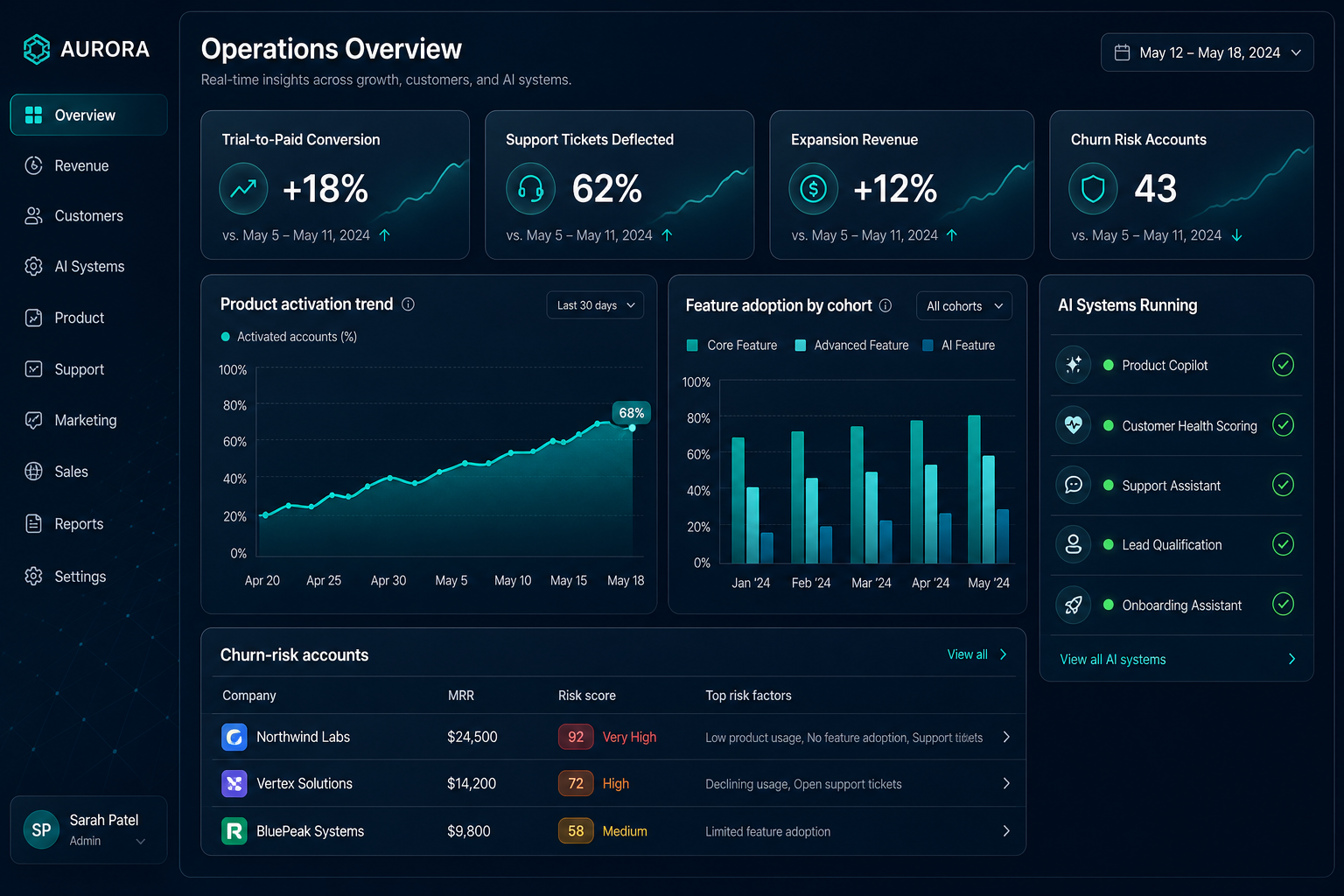
Different products, similar problems. These are the recurring patterns we see across SaaS organisations — and the ones that AI is genuinely well-suited to solve.
Boards and customers expect AI in the product, but it's hard to separate features that move retention from features that just look good in a launch post.
Support headcount scales linearly with customers. The same questions get answered hundreds of times a week by humans — questions the product itself should resolve.
Thousands of signups, a long tail of low-intent users, and no reliable way to surface the accounts that look like the ones that turned into real revenue.
Customer success teams react to churn after the renewal call. Health scores rely on generic engagement metrics rather than patterns from your actual lost deals.
Product docs, runbooks, past tickets and internal wikis live in five tools. Every team rediscovers the same answers because nothing is genuinely searchable.
If two or three of these match your reality, there's almost certainly a high-value AI workflow we can scope in a 30-minute call.
Five areas where SaaS companies see measurable business outcomes from production AI — not lab demos.
Embedded copilots and intelligent assistants that sit inside the product, accelerate time-to-value, and become a real reason customers stay.
Reduce repetitive ticket volume by resolving the high-confidence questions automatically and routing the rest to humans with full context attached.
Identify churn risk before the renewal call and surface expansion opportunities based on real usage patterns from accounts that grew.
Prioritise the high-intent accounts hiding in PLG signups, with explainable scores SDRs can actually act on rather than a black-box number.
Give product, support and CS teams a single place to ask questions and get cited answers from your runbooks, docs and historical tickets.
Every engagement starts with a measurable business outcome — activation, retention, deflection, expansion — not "let's add some AI".
Many SaaS organisations can build an AI proof-of-concept in a sprint. The harder problem is deploying AI systems that are secure, scalable and maintainable — and keeping them running once real customers depend on them.
Design
Scope the right workflow, define the business outcome, agree the measure of success
Build
Integrate with product data, train and evaluate against real customer scenarios
Deploy
Ship to managed Azure or AWS infrastructure with CI/CD and proper environments
Monitor
Track quality, latency, cost and drift — with alerts before customers feel them
Support
Ongoing managed support, model refresh and incremental improvements over time
A simplified view of how the pieces fit together — from your product data through the AI layer into the customer experience, with monitoring and support wrapped around it.
Production flow
Most SaaS engagements begin with an AI readiness assessment or focused strategy sprint. We identify the product or operational workflow with the clearest measurable outcome, then design it for production.
A 30-minute call. No pitch deck, no slideware. If we can help, we'll tell you how. If we can't, we'll point you somewhere that can.